Feelings wheel

Tap the feeling closest to how you feel right now. Nothing you pick is saved or sent.
Which is closest?
Tap the core feeling closest to how you feel right now. You can go back at any time.
If a feeling here is too heavy to sit with, you don't have to sort it out alone. If you're thinking about harming yourself, call or text 988 in the US, or see crisis resources.
Prefer paper? Download the printable wheel (PDF).
How to use the feelings wheel
- Start in the middle. Pick the core feeling that is closest, even if it's only roughly right. Scared covers a busy mind before a hard meeting, not only fear.
- Move one ring out. Choose the feeling inside it that fits better, such as overwhelmed or anxious inside scared.
- Go one step further if a word clicks. Swamped and frazzled are both kinds of overwhelmed, and they point at different next steps.
- Read the meaning and check it against the moment. If it doesn't fit, tap a nearby word or go back.
- Answer the prompt. Two or three sentences on paper are enough, or say them out loud to Joy.
- Pick a second word if one isn't enough. A hard week that finally ends can leave you relieved and sad at once.
Which word did you land on, and what happened in the last day that brought it on?
Answer this with JoyWhat a feelings wheel is
A feelings wheel, also called an emotion wheel or a wheel of emotions, is a circle of feeling words. Broad feelings sit in the middle, and more exact ones sit toward the edge. You move outward until a word fits.
The original, for naming feelings, is Gloria Willcox's Feeling Wheel, from a 1982 issue of the Transactional Analysis Journal.1 Her starting point was four basic feelings, mad, sad, glad and scared, and she split glad into joyful, powerful and peaceful, which left six at the center.1
Plutchik's wheel is a different model. Robert Plutchik arranged eight basic emotions in pairs of opposites: joy and sadness, trust and disgust, fear and anger, surprise and anticipation.2 It explains how emotions relate.
A Willcox-style wheel is built for finding the word.
How this wheel is different
This wheel keeps Willcox's idea and uses our own grouping and plain words. It is not a copy of her layout.
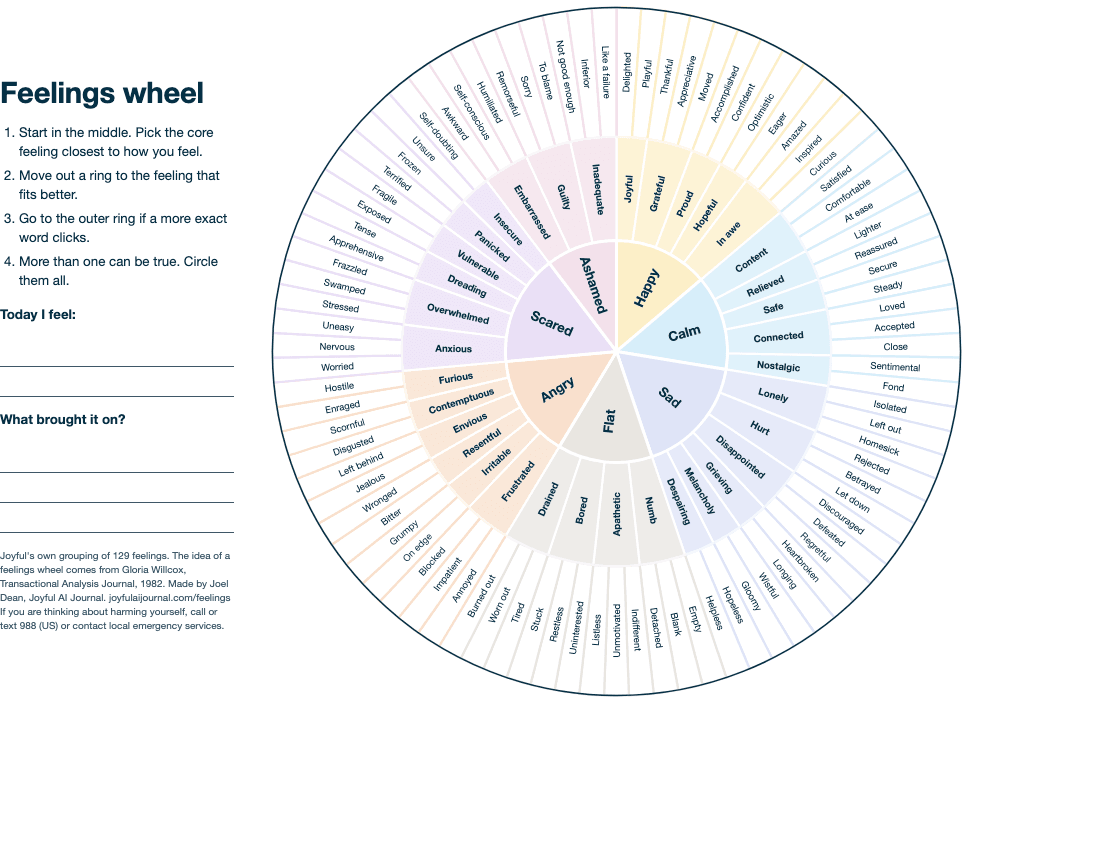
- Happy: Joyful, grateful, proud, hopeful, in awe
- Calm: Content, relieved, safe, connected, nostalgic
- Sad: Lonely, hurt, disappointed, grieving, melancholy, despairing
- Flat: Numb, apathetic, bored, drained
- Angry: Frustrated, irritable, resentful, envious, contemptuous, furious
- Scared: Anxious, overwhelmed, dreading, vulnerable, panicked, insecure
- Ashamed: Embarrassed, guilty, inadequate
Two choices are ours.
Flat gets a family of its own. Numb, apathetic, bored and drained are about feeling too little, and filed under sad they're hard to find.
Ashamed does too. Researchers group shame, guilt and embarrassment together as the self-conscious emotions, since each turns on how you see yourself,3 so on this wheel they share a ring.
Every one of the 129 words has a one-line meaning, nearby words and its own journal prompt. Body notes appear only for the four emotions a published body-mapping study described in words (more on that below).
Why naming a feeling helps
Putting a feeling into words has a name in research: affect labeling. A brain imaging study found it lowered the amygdala's response to emotional photos, compared with other ways of looking at them,4 and the list of emotions tells that study in full. A later review describes labeling as a quiet form of emotion regulation that may not even feel like regulating while it happens.5
Exact words seem to matter too. People who describe their feelings in finer detail, called emotion differentiation or granularity, were less likely to turn to binge drinking or aggression when distressed.6 Those studies are correlational, so they don't prove that a wheel builds the skill, but they're the reason this wheel goes past "bad" to words like swamped, wronged or left out.
Rings and colors are a design choice
Naming feelings, and naming them precisely, has the evidence above behind it.5 The layout has no such backing. No study we know of tests one wheel layout against another, so the rings and colors on any wheel, ours included, are somebody's design decision.
The wheel is not a test, and a word you pick is not a diagnosis.
Some words, like numb, hopeless or drained, are worth raising with a doctor if they stay with you.
If looking closely at a feeling makes it stronger, it's fine to stop and come back later. If you don't feel safe, the crisis resources page lists who to call, including 988 in the US.
Feelings in the body
More than 700 Finnish, Swedish and Taiwanese speakers colored in a body outline to show where they felt each emotion, in the study this wheel's body notes come from.7 Happiness showed up all over the body. Anger showed up most in the upper body and arms. Sadness came with less feeling in the arms and legs, and disgust centered on the throat and stomach.7
Feelings such as shame, envy and pride produced weaker maps in the same study.7 That's why the wheel shows a body note only for happy, sad, angry and disgusted.
All 129 words in a list
Prefer to scan? The list of emotions has every word on this wheel, family by family, with its meaning.
Print or save it
The result card has Copy, Share and Print buttons. Print sends only your card to the printer. Share opens your phone's own share sheet, and nothing passes through Joyful.
- US Letter: /printables/feelings-wheel-worksheet-letter.pdf
- A4: /printables/feelings-wheel-worksheet-a4.pdf
The printable wheel shows all three rings on one page. It prints well in black and white, and you can color the families in by hand.
Questions people ask
How does the feelings wheel work?
You start with a broad feeling in the middle and move outward to a more exact one. The outer words are kinds of the feeling they sit next to. On this wheel, swamped and frazzled are both inside overwhelmed, which is inside scared.
Is a feelings wheel the same as an emotion wheel?
People use the two names for the same kind of tool. "Emotion wheel" sometimes means Plutchik's wheel of eight basic emotions in particular, which is built to show how emotions relate rather than to help you find a word.2
Which emotion wheel is best?
Use the one whose words sound like you. Willcox's wheel is the original for naming feelings.1 Plutchik's suits learning a theory of emotion.2 This one is made for a phone, in plain words, with a prompt for each word.
What are the 27 emotions?
They're the categories Alan Cowen and Dacher Keltner drew out of people's ratings of 2,185 short videos in 2017, among them amusement, awe, nostalgia and boredom, with smooth blends between many of them.8 Treat it as a research map. Nobody needs to learn the 27.
Can kids use a feelings wheel?
Yes, though this one is written for adults. With a young child, the seven core words are a good place to start. Words like contemptuous or apprehensive can wait.
How do you feel emotions in your body?
Start by noticing where the feeling sits: a tight chest, a hot face, heavy arms. The body-mapping study above found patterns that held across all three language groups.7 Your own map may differ, and that's fine.
Related
- List of emotions: every word on the wheel with its meaning.
- Overwhelmed, anxious and shame: three of the feelings people look up most.
- Thought record: once you've named the feeling, look at the thought behind it.