Thought record

Nothing you type is saved or sent.
The moment
Just the facts, as a camera would record them.
If writing this out leaves you feeling worse, it's fine to stop and come back later, or to talk to someone you trust. If you're thinking about harming yourself, call or text 988 in the US, or see crisis resources.
If you'd rather write on paper, download a blank worksheet (PDF).
How to use it
- Pick one moment from today that still stings. Small is fine.
- Write the thought in the exact words it came in, and rate how much you believe it.
- Name the feeling and how strong it is.
- Say whether the thought is about something that might happen later, because worries take a different path.
- Write a fuller view in your own words, then rate the thought and the feeling again.
The numbers are only for you, so you can compare your two ratings and see whether anything moved. It takes about 5 to 10 minutes.
Which part of the record surprised you most: the thought, the feeling, or what you wrote when you looked at it again?
Answer this with JoyWhat a thought record is
A thought record, also called a thought diary or thought log, is a worksheet for slowing down one upsetting moment so you can separate what happened from what you thought about it, and from how that thought made you feel. Aaron Beck and his colleagues used a version of it, the Daily Record of Dysfunctional Thoughts, in their 1979 manual for cognitive therapy of depression.1 The seven-column version comes from the self-help book Mind Over Mood.2
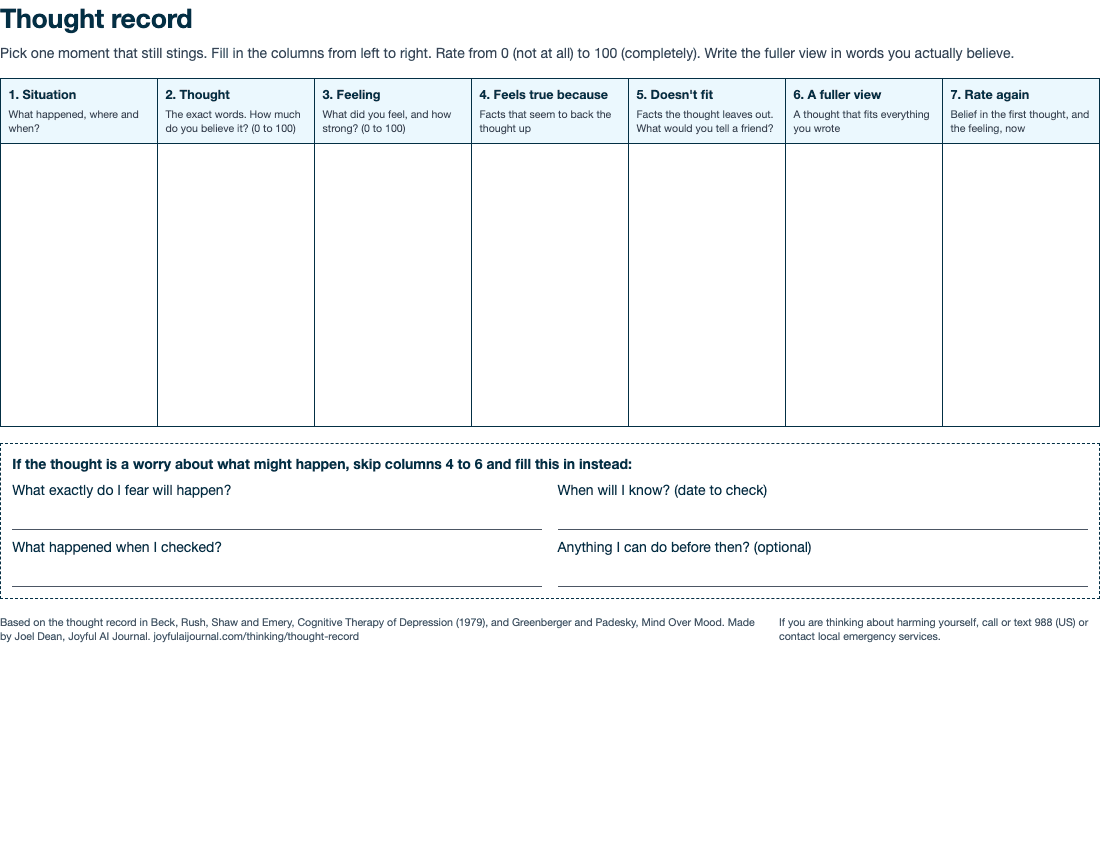
A paper worksheet might be at home when you need it, or it might be the middle of the night and your thoughts are racing, so the one above works on a phone. It asks for seven parts, in this order.
- Situation: What happened, where and when, as a camera would see it.
- Thought: The words that went through your mind, and how much you believe them.
- Feelings: What you felt, and how strong, from 0 to 100.
- What makes it feel true: The facts that seem to back the thought up.
- What doesn't fit: Facts the thought leaves out.
- A fuller view: A version of the thought that fits everything above.
- Rate again: How much you believe the first thought now, and how strong the feeling is.
A worked example
The record below is made up, and it follows one message through all seven parts.
| Situation | Thought | Feeling | Feels true because | Doesn't fit | Fuller view | After |
|---|---|---|---|---|---|---|
| My manager wrote "Can we talk tomorrow?" with no details. | "She's unhappy with my work." (believed 75) | Anxious, 80 | She's been short with me this week. | My last review was good. She sets up talks like this for new projects too. | "I don't know what it's about yet. It could be good, neutral or a problem I can fix." | Thought 35, anxious 45 |
- Thought:
- "She's unhappy with my work." (believed 75)
- Feeling:
- Anxious, 80
- Feels true because:
- She's been short with me this week.
- Doesn't fit:
- My last review was good. She sets up talks like this for new projects too.
- Fuller view:
- "I don't know what it's about yet. It could be good, neutral or a problem I can fix."
- After:
- Thought 35, anxious 45
I'd look at the fuller view first. It doesn't say everything is fine. It's a thought the person can believe, because it fits the facts on both sides, and I think that's why the anxiety dropped from 80 to 45 instead of to zero.
If your own fuller view feels fake, it probably is. Write the version you can believe, even if it's only a little different from the first thought.
Why worries take a different path
The classic worksheet asks you to weigh the evidence for and against the thought, and that suits thoughts about yourself or about something that's already happened. A worry about the future is harder to weigh, because the outcome hasn't happened yet, so most of the "evidence" on either side is a guess and you can go back and forth on it for hours. Checking what happens later gives you something new to go on.
For a worry, the tool asks something else: what exactly do you fear will happen, and when will you know? In a study of 29 people with generalized anxiety disorder, those who logged their worries and checked them later had expected bad outcomes far more often than they happened, and those with more untrue worries improved more over treatment.3 The worry time page has the full study.
Does one thought record help?
Among 91 adults, one thought record lowered belief in a negative thought, and so did one behavioral experiment (doing something to test the thought); belief changed sooner with the experiment and spread further, and both beat the comparison group.4 In therapy for depression, symptoms were lower after sessions where the therapist asked more questions that helped the person examine their own thought, though that finding is correlational.5
What isn't settled is why. Changes in thinking go along with feeling better, but it hasn't been shown that the thought record itself is the active ingredient.6
In CBT, doing more practice between sessions goes with better outcomes.7 Repetition seems to count, so I'd treat any one record as practice.
Print or save it
Nothing you type is stored, so once you leave the page the record is gone, and if you want to keep it you'll need to print it or copy it before you go. The Print button on the last step prints only your filled-in record. For a worry, the tool can also add your check date to your calendar, without the worry itself.
- US Letter: /printables/thought-record-worksheet-letter.pdf
- A4: /printables/thought-record-worksheet-a4.pdf
To fill one in by hand, download the blank worksheet above. It prints well in black and white.
Questions people ask
What are the columns of a thought record?
The common seven-column version has: situation, feelings, automatic thought, evidence that supports it, evidence that doesn't, a balanced or alternative thought, and a rating of the feeling afterward.2 Shorter versions use three or five columns. Mind Over Mood puts feelings before the thought, and this tool asks for the thought first, because I think it's usually easier to name the feeling once the words are on the page.
How often should you do a thought record?
There's no set number, so I'd do one when a strong feeling hits and try to do it the same day, while the exact words of the thought are still clear.
Is a thought record the same as journaling?
It's a kind of structured journaling. Free writing lets you follow the feeling wherever it goes, and a thought record gives you a fixed set of questions, which helps when your mind keeps going around the same loop.
What if I can't find any evidence against the thought?
If a friend brought you the same thought, you'd probably find something to say back. Write that down. In experiments, looking at a moment as an outsider would had a small advantage over replaying it from the inside, though the evidence was uncertain.8 The Socratic questioning page goes through it. If the thought is about the future, use the worry path instead.
Related
- Cognitive distortions: the 10 thinking patterns a thought record helps you spot.
- What is CBT?: the therapy the thought record comes from.