CBT worksheets

Start with the thought record here on the page, or print any worksheet below. Nothing you type leaves your device.
The moment
Just the facts, as a camera would record them.
If writing this out leaves you feeling worse, it's fine to stop and come back later, or to talk to someone you trust. If you're thinking about harming yourself, call or text 988 in the US, or see crisis resources.
All four worksheets are free PDFs in US Letter and A4, with no email or sign-up. They print well in black and white.
How to use these worksheets
- Pick the sheet that fits the thought. The guide just below matches each kind of thought to a worksheet.
- Fill it in the same day. Thoughts fade fast, and the exact words are what you need.
- Do one at a time. One worksheet about one moment is enough. Small is fine.
- Bring it to your therapist, if you have one. Worksheets are the practice that happens between sessions.
- Look back after a week or two. Patterns can show up across several sheets that you might not see in one.
These are practice tools, not treatment. If writing brings up more than you can handle, stop, and see crisis resources for someone to talk to right now.
Which worksheet for which thought
- Thought record: A thought about yourself or about something that already happened.
- Worry log: A worry about what might happen, which you can check on a date.
- Behavioral experiment: A belief you can test by doing something, such as "if I say no, she'll be angry".
- Cognitive distortions list: Any thought, when you want to name the pattern first.
For most thoughts, the first one is enough. The worry log is the one to reach for at night, when the thought starts with "what if".
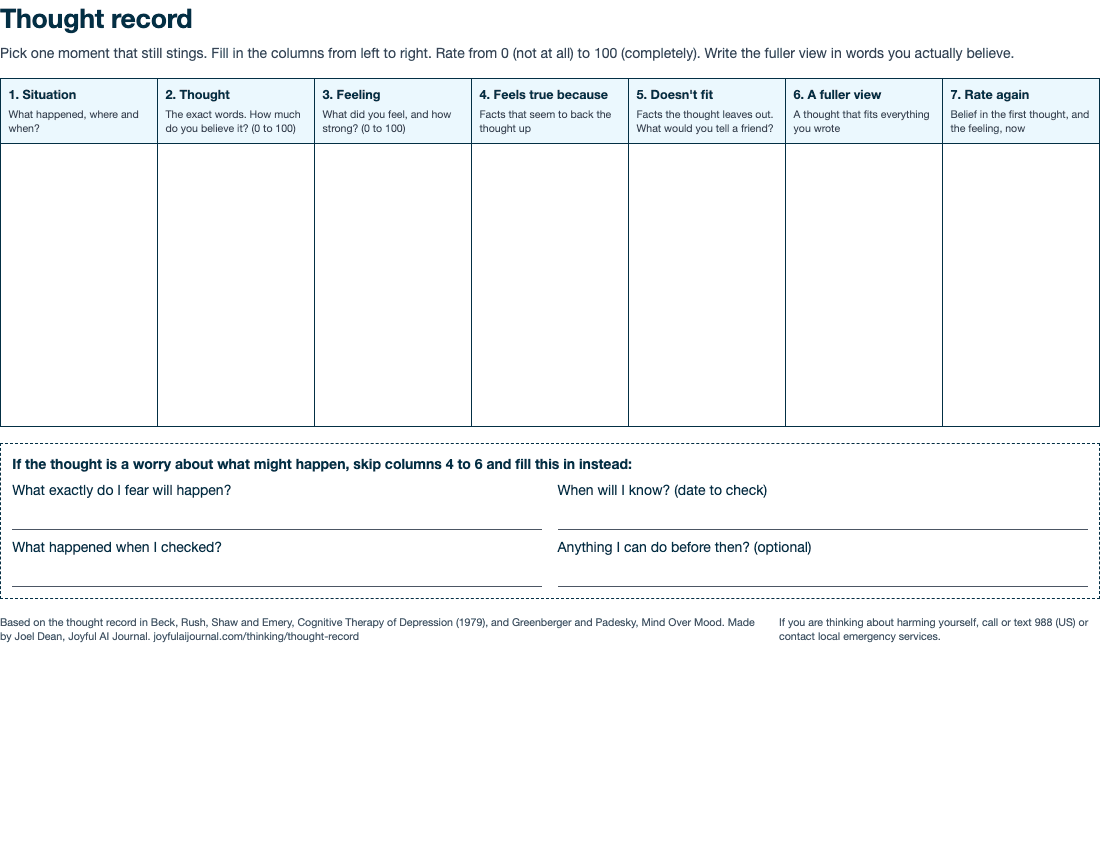
Thought record
Start here. It splits one moment into what happened, what you thought and what you felt, then asks what fits the thought and what doesn't. It goes back to the 1979 manual for cognitive therapy of depression by Aaron Beck and his colleagues, and the seven columns on this sheet follow Mind Over Mood.1,2
Use it for thoughts like "I made a fool of myself" or "I'm not good enough for this." You can fill it in online or print it.
- US Letter: /printables/thought-record-worksheet-letter.pdf
- A4: /printables/thought-record-worksheet-a4.pdf
Worry log
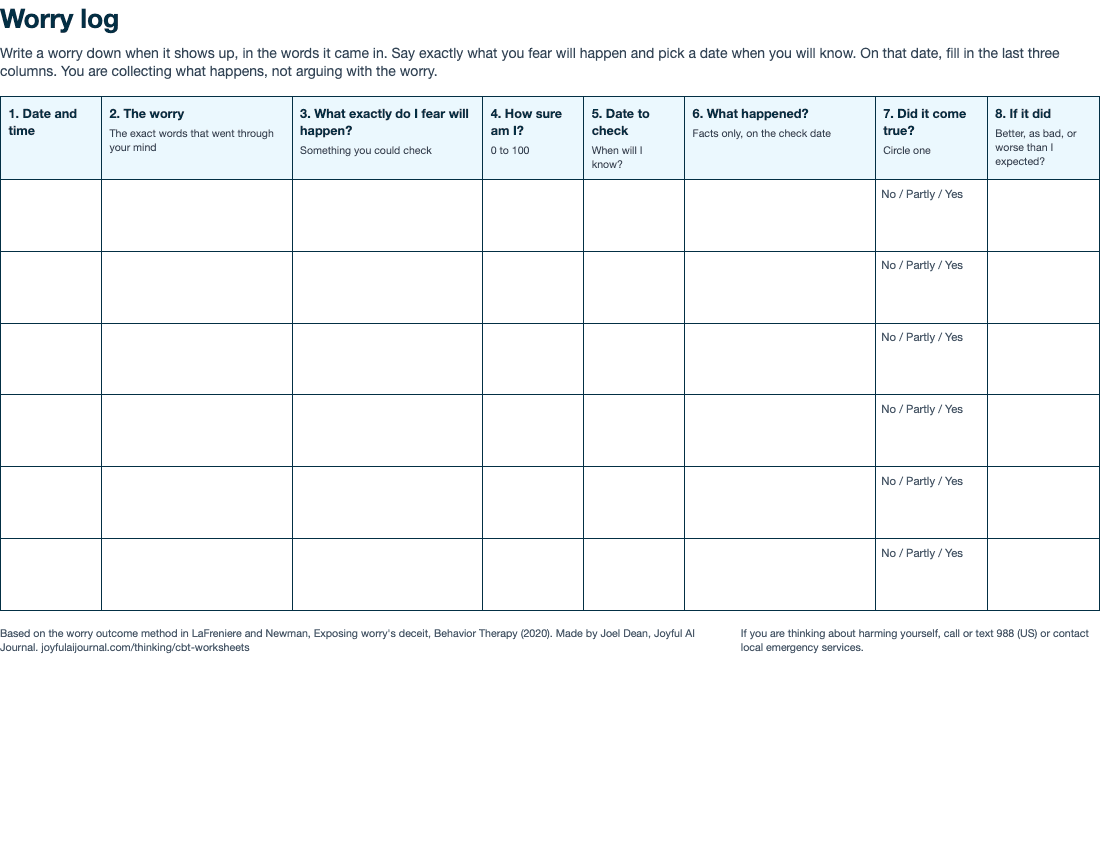
A worry about the future can't be weighed the way a thought about the past can, because the outcome hasn't happened. This sheet doesn't ask you to argue with the worry. It asks for exactly what you fear, how sure you are, and the date you'll know.
On that date, you write what happened.
The columns follow Lucas LaFreniere and Michelle Newman's study, in which 91.4 percent of the worry predictions that 29 people with generalized anxiety disorder logged did not come true.3 The last column asks whether a worry that did come true was better, as bad or worse than you expected, which the study also tracked.3 The worry time page has the rest of the study.
"Thursday, 11 p.m. Worry: the doctor will find something wrong. What I fear: the blood test will show a serious problem. How sure: 70. Check date: results on Tuesday."
- US Letter: /printables/worry-log-worksheet-letter.pdf
- A4: /printables/worry-log-worksheet-a4.pdf
Behavioral experiment
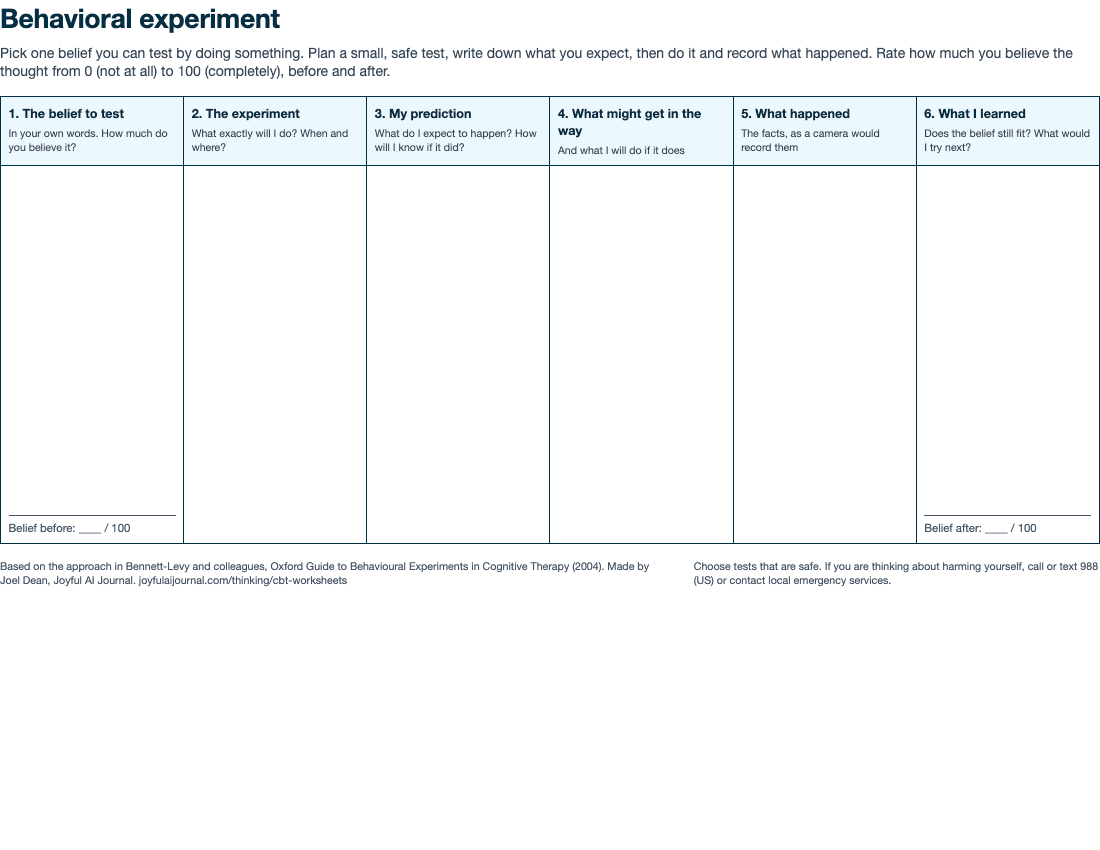
Some beliefs are best tested by doing something. "If I say no to my sister, she'll be furious" can be argued with forever, or tested once. This sheet walks through the belief, a small and safe test, your prediction, what might get in the way, what happened and what you learned.
The method is set out in the Oxford Guide to Behavioural Experiments in Cognitive Therapy.4 Belief in a negative thought changed sooner after one experiment than after one thought record in a study of 91 adults, though both lowered it.5 The behavioral experiments page shows how to design a fair test.
"Belief: if I speak up in the meeting, people will think my idea is stupid (80). Test: share one idea on Wednesday. Prediction: silence or someone dismisses it. What happened: two people asked questions about it. Belief now: 45."
- US Letter: /printables/behavioral-experiment-worksheet-letter.pdf
- A4: /printables/behavioral-experiment-worksheet-a4.pdf
Cognitive distortions list
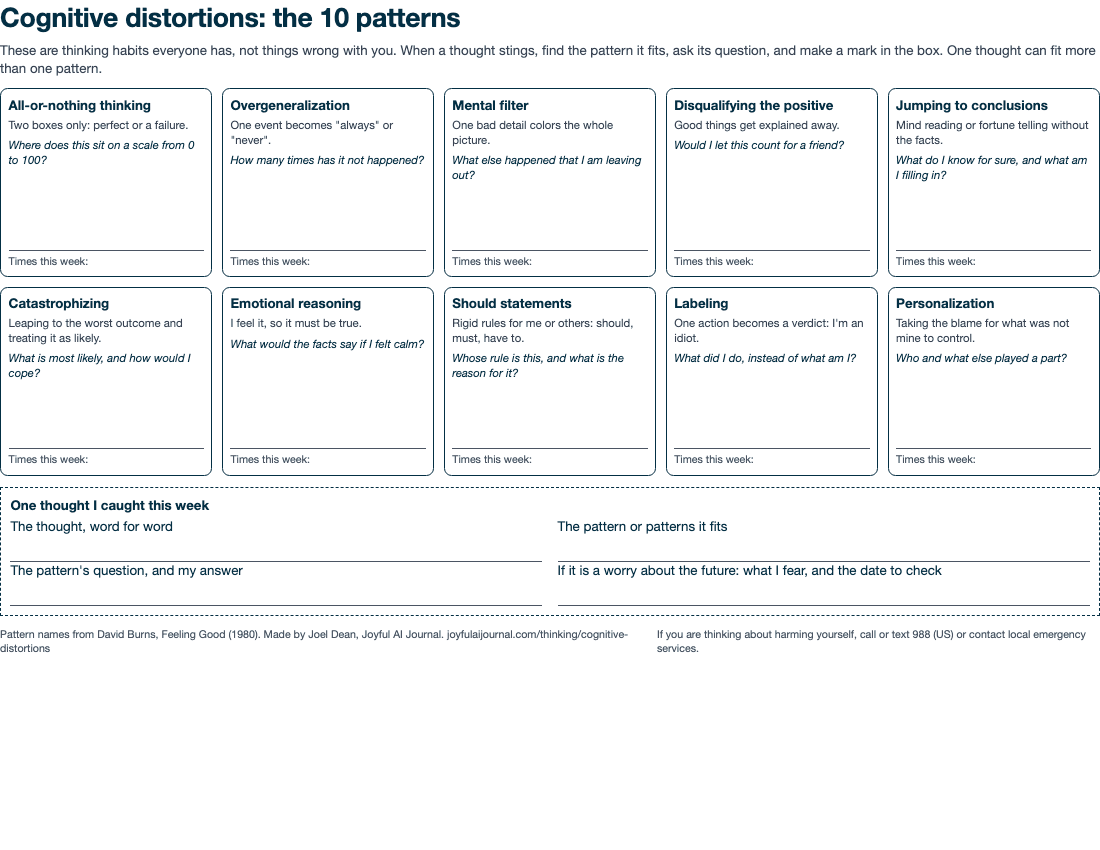
A one-page list of the 10 thinking patterns from David Burns' Feeling Good, each with one plain question to ask and a box to mark when you catch it.6 At the bottom there's space to write one thought you caught and the pattern it fits.
Keep it beside a notebook or on the fridge. Naming the pattern is a first step, and it rarely settles the thought on its own, so use it with one of the sheets above. Each pattern has its own page, such as catastrophizing, should statements and all-or-nothing thinking.
- US Letter: /printables/cognitive-distortions-worksheet-letter.pdf
- A4: /printables/cognitive-distortions-worksheet-a4.pdf
Homework, in 17 studies
CBT therapists often set this kind of practice as homework. Across 17 studies of CBT, people who did more of their practice between sessions had better outcomes.7 That's a link, and it doesn't prove worksheets alone cause change.
They're a way to practice a skill. If you've done a few and nothing is shifting, or you feel worse after them, bring them to a CBT therapist, who can help you see patterns across the sheets that are hard to spot from inside.
Which kind of thought has been loudest this week: something about yourself, something that already happened, or a worry about what might happen? Write one down in its exact words.
Answer this with JoyQuestions people ask
Are these CBT worksheets free?
Yes. All four are free to download and print, with no email, sign-up or account. The thought record also works online, and nothing you type is saved or sent.
Can I use CBT worksheets without a therapist?
Yes. The homework studies above are of people in therapy, though, where someone set the homework and looked at it with them. Using the sheets alone is reasonable practice with less evidence behind it.
Which CBT worksheet should I start with?
The thought record, for most thoughts. If the thought is a worry about something that hasn't happened yet, start with the worry log instead.
Can I fill these in on my phone?
The thought record works on a phone. The others are print PDFs for now. You can also keep the same columns in a notes app.
Related
- Thinking patterns: guides to each pattern these sheets help you catch.
- Thought record: the online version, with a separate path for worries.
- Cognitive distortions: the 10 patterns, with everyday examples.
- What is CBT?: the therapy these worksheets come from.