Breathing exercises for anxiety

Press Start and breathe along: one breath in through your nose, a second short breath in on top, then a long, slow breath out. Ten rounds take about a minute and a half. Want a simpler count? Tap Longer exhale (4-6).
Cyclic sighing: 10 rounds, about 1 min 30 sec.
If you feel dizzy, short of breath or more anxious, stop and breathe normally. A shorter count is fine. If you're thinking about harming yourself, call or text 988 in the US, or see crisis resources.
The pacer starts on cyclic sighing, the pattern that lifted mood most in a month-long trial.
1. Cyclic sighing
A double breath in, then a long, slow breath out.
Of the four practices that 108 people tried for 5 minutes a day over a month in a 2023 Stanford study (cyclic sighing, box breathing, fast breathing and mindfulness meditation), cyclic sighing lifted mood the most and slowed breathing the most, compared with meditation. Every group felt less anxious after each session.1
- Sit or lie down, and set a timer for 5 minutes.
- Breathe in slowly through your nose until your lungs feel full.
- Take a second, shorter breath in through your nose, to top them up.
- Breathe out slowly through your mouth, all the way, until your lungs feel empty.
- Repeat until the timer ends. Your own pace is fine.
The second breath in is shorter, as the study described it.1
"Sitting in my car before going into the office, I did the double breath in and a long, slow sigh out, over and over until the five minutes were up."
2. A longer breath out
Breathe in for 4 and out for 6, with no holds. That's about 6 breaths a minute. Tap Longer exhale (4-6) on the pacer above to follow it.
- Breathe in through your nose for a count of 4.
- Breathe out slowly, through your nose or pursed lips, for a count of 6.
- Keep going for 1 to 2 minutes, or longer if it feels good.
Breathing at 6 a minute raised heart rate variability more than box or 4-7-8 breathing did when 84 students tried all three in a 2025 lab study.2 Higher variability is generally read as the body shifting toward rest. And in a 2021 study, a single session of slow breathing with a longer exhale lowered anxiety scores in younger and older adults alike.3
"Waiting for test results, I counted in for 4 and out for 6 on my fingers, and kept my eyes on the clock."
3. Belly breathing
Also called diaphragmatic breathing. This is the NHS's own breathing exercise for stress.4
- Sit in a chair that supports your back, or lie down. Put a hand on your belly.
- Let your breath go as deep into your belly as is comfortable, without forcing it.
- Breathe in through your nose, counting steadily from 1 to 5. You may not reach 5 at first.
- Breathe out gently through your mouth, counting from 1 to 5 again.
- Keep going for at least 5 minutes.
The NHS says you'll get the most from it if you do it regularly, as part of your day.4 A small trial put that to work. It split 40 adults in two, and half practiced belly breathing with a feedback device, at about 4 breaths a minute, for 20 sessions over 8 weeks. Afterward that half reported less negative mood and showed lower levels of cortisol, a stress hormone, while the other half's cortisol stayed where it was.5
"Before bed, I lay on my back with one hand on my stomach, watching it rise, and counted to 5 each way."
4. Box breathing
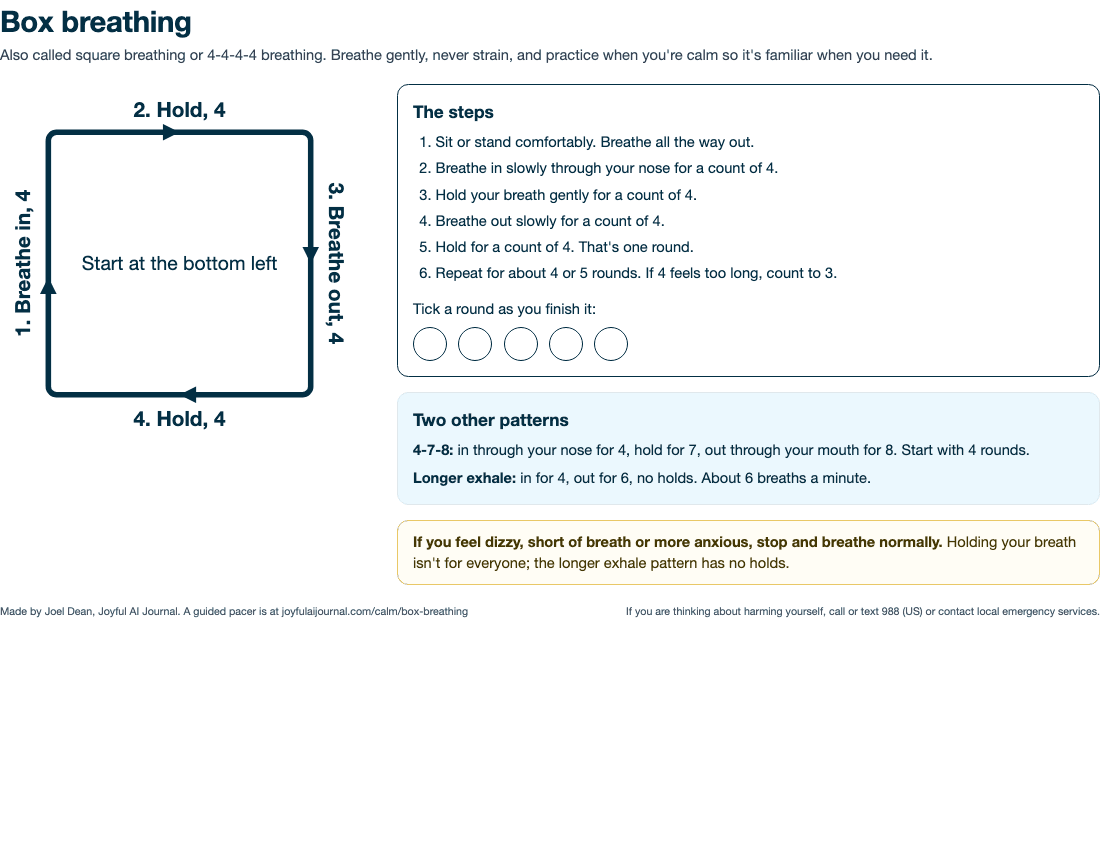
In for 4, hold for 4, out for 4, hold for 4. Easy to remember. You can do it with your eyes open, on a train or in a waiting room, and nobody around you will know. The box breathing pacer has the full steps. In the Stanford study, it helped. Not significantly more than meditation did, though.1
"On the train, I traced a square on my knee with one finger: up, across, down, across."
5. 4-7-8 breathing
In for 4, hold for 7, out for 8. Dr. Andrew Weil made it popular, and his handout says to start with no more than 4 breaths at a time.6 It has few studies of its own. The 4-7-8 breathing page has a timer and the evidence.
"I tried 4-7-8 lying in bed, counting quickly, because the hold of 7 felt long at first."
- You have 5 minutes and want the best-tested option: Cyclic sighing, a double breath in and a long breath out.
- You want the simplest pattern: In for 4, out for 6.
- You're lying down or winding down: Belly breathing, counting to 5 each way.
- You're in public with your eyes open: Box breathing, tracing a square.
- Holding your breath makes you tense: Skip box and 4-7-8. Use the longer breath out.
Do breathing exercises work for anxiety?
A little, on average, which makes a breathing exercise a fair first thing to try when anxiety spikes. It isn't a treatment for an anxiety disorder, and the evidence is still building.
- Across trials. A 2023 meta-analysis pooled 20 randomized trials on anxiety. Breathwork lowered anxiety a little more than control conditions did. Most trials had a moderate risk of bias, and the authors warned against hype.7
- Slow breathing in healthy adults. A review of 15 studies found that breathing under 10 times a minute went with more relaxation and less anxiety.8 The authors called the evidence limited.
- Panic disorder. A review of nine studies said the evidence was not strong enough to judge breathing training on its own for panic disorder.9 UK guidelines recommend cognitive behavioral therapy for panic disorder.10
If anxiety is running your days, talk to a doctor. How to calm anxiety covers what helps beyond the breath.
When breathing makes anxiety worse
Breathing exercises are generally safe for healthy people, but now and then they bring on more anxiety, intrusive thoughts or a fear of losing control.11
- Dizzy, tingly, short of breath or more anxious? Stop and breathe normally.
- Keep the breaths gentle and small. In the 2025 lab study, breathing at 6 a minute led to mild over-breathing.2
- If you have trouble breathing, use oxygen, or get dizzy easily, talk with your doctor first.12
- If the breath isn't working for you, try 5-4-3-2-1 grounding, which uses your senses instead.
- If this feels like a panic attack with chest pain, read what helps during a panic attack, including when to call 911.
If you're thinking about harming yourself, call or text 988 in the US, or see crisis resources.
Which of these did you try? What did you notice in your body before, and after? Was there a moment it helped, or a moment it felt harder?
Answer this with JoyPrint a breathing guide
The sheet covers box breathing, 4-7-8 and the longer breath out. Cyclic sighing isn't on it: you set your own pace, so there's nothing to count.
- US Letter: /printables/box-breathing-worksheet-letter.pdf
- A4: /printables/box-breathing-worksheet-a4.pdf
Questions people ask
What is the best breathing exercise for anxiety?
No single one has been proven best. Only two studies here put patterns head to head, with 108 and 84 people, and each is a single study.1,2 That's too little to crown a winner, so pick the one you'll repeat. The plain 4-6 count is the easiest to learn, with nothing to hold.
What is the 3-3-3 rule for anxiety?
Look around and name three things you can see, listen for three sounds, then move three parts of your body. It's a grounding exercise rather than a breathing one, and we found no trials of it. For a fuller version with a guide, try grounding techniques.
How can I calm down my nervous system?
Slow your breathing, with a long breath out. In studies, it goes with a rise in heart rate variability, a sign the body is moving toward rest.2,8 Moving your body may help too: across 97 reviews, physical activity lowered anxiety symptoms, though most of those reviews were rated critically low in quality.13
How long should I do breathing exercises for anxiety?
Try a minute or two first. The Stanford study used 5 minutes a day, and the NHS suggests at least 5 minutes, so build up to that if the first try felt good.1,4
Do breathing exercises help during a panic attack?
Slow breathing is reasonable to try, but the evidence for panic is mixed.9 Don't breathe into a paper bag. The panic attack page explains why, and when to get emergency help.
Related
- Box breathing and 4-7-8 breathing: each with its own pacer.
- Box breathing vs 4-7-8: how they compare in the one head-to-head study.
- How to calm anxiety: steps for the moment and for the days after.
- Journal prompts for anxiety: for once your breathing has settled.