Box breathing

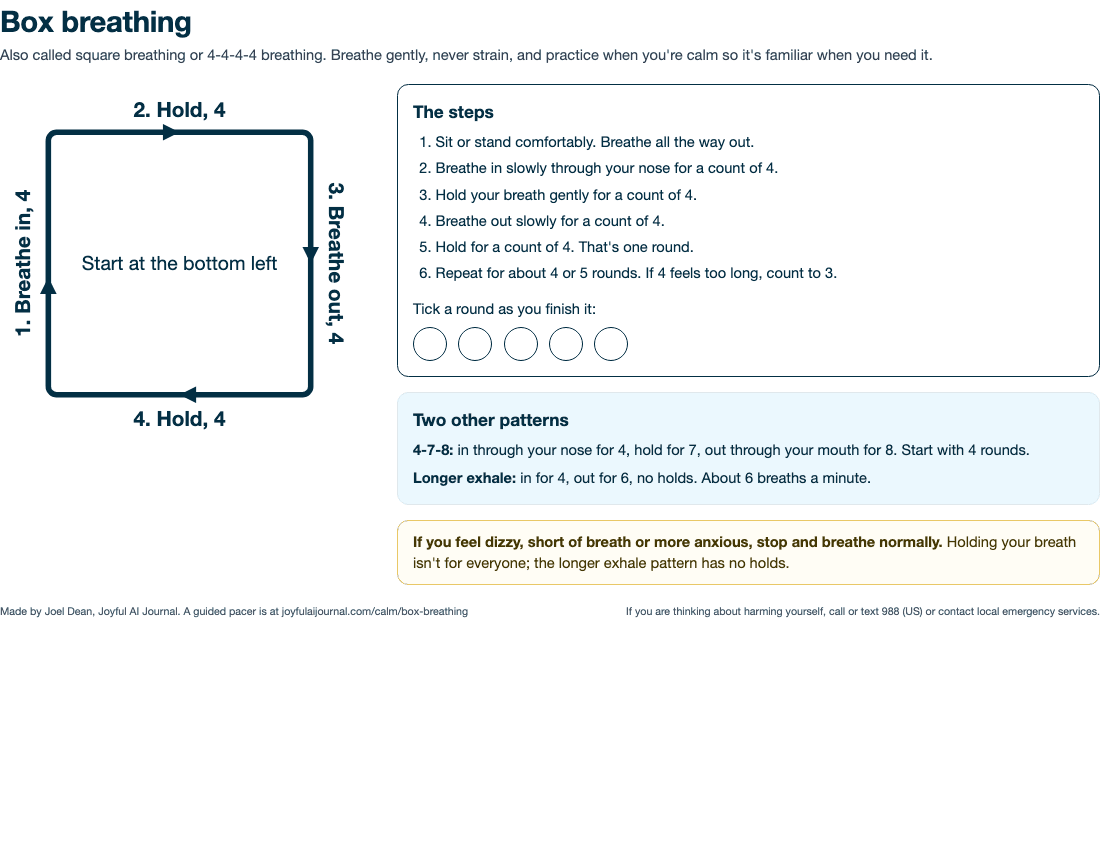
Press Start and follow the square: breathe in up the left side, hold across the top, breathe out down the right, hold along the bottom.
Box breathing: 5 rounds, about 1 min 20 sec.
If you feel dizzy, short of breath or more anxious, stop and breathe normally. A shorter count is fine. If you're thinking about harming yourself, call or text 988 in the US, or see crisis resources.
Prefer paper? Download the one-page guide (PDF).
How to do box breathing
Four sides, four counts, and you're back where you started.
- Sit or stand comfortably. Let your shoulders drop, and breathe all the way out.
- Breathe in slowly through your nose for a count of 4.
- Hold your breath gently for a count of 4. Just pause; don't clamp your throat.
- Breathe out slowly for a count of 4.
- Hold again for a count of 4. That's one round.
- Repeat for 4 or 5 rounds, a little over a minute. If 4 feels too long, count to 3.
Cleveland Clinic's advice is to stay at your comfort level, never strain, and practice when you're calm so the square is familiar by the time you need it.1 The pacer lets you pick a 3, 4 or 5 second count, so you can start where it feels comfortable.
"In the car before my interview, I did four rounds, tapping the count on the steering wheel. Then I walked in."
How did your body feel before you started, and how does it feel now? Where did you notice a difference, if anywhere?
Answer this with JoyOther names for the same steps
Square breathing, four-square breathing, 4x4, 4-4-4-4, equal breathing, and in yoga, sama vritti pranayama: all the same four even steps.1 Harvard Health calls it tactical breathing and says military and police personnel use it to stay calm under pressure.2
- Breathe in: Up the left side, through your nose, for 4.
- Hold: Across the top, gently, for 4.
- Breathe out: Down the right side, slowly, for 4.
- Hold: Along the bottom, for 4, then start again.
The holds are what make it a box. They're also the part some people don't like.
What happened when researchers tested the box
In the studies here, box breathing calmed people, though it didn't clearly beat the alternatives. Two studies here put it next to something else.
Over 28 days, 108 people did 5 minutes a day of box breathing, cyclic sighing (a double inhale, then a long exhale), fast breathing, or mindfulness meditation, and every group felt less anxious after each session.3 Breathwork as a whole lifted mood more than meditation, but box breathing on its own wasn't significantly better than meditation. Cyclic sighing came out on top.3
The second study turned up the pressure. Thirty people did a timed task while the noise around them got louder. Tactical breathing lowered their physical arousal more than a long exhale did, the long exhale went with better task performance, and people felt equally stressed with either one.4
Slow breathing in general has small effects across randomized trials,5 on top of limited evidence from healthy adults,6 and breathing exercises for anxiety goes through that research. The one lab test that put the box beside 4-7-8 and a steady 6 breaths a minute is on box breathing vs 4-7-8; the 6 a minute did most for heart rate variability there.7
Box breathing is easy to remember, which helps when you're stressed. If the holds bother you, drop them. Breathe in for 4 and out for 6 instead; in the one lab test that compared them, that steady 6 breaths a minute raised heart rate variability more than the box did.7
The pacer's other two patterns
| Pattern | How it goes | Good to know |
|---|---|---|
| Box breathing | In 4, hold 4, out 4, hold 4 | Easy to remember. The holds are not for everyone. |
| 4-7-8 | In 4, hold 7, out 8 | Taught by Dr. Andrew Weil. A little lightheadedness is common at first. |
| Longer exhale | In 4, out 6, no holds | About 6 breaths a minute. No holds, so it suits people who find holding uncomfortable. |
Weil's handout says to start 4-7-8 with no more than 4 breaths at a time for the first month.8 The longer exhale is close to the 4-in, 6-out pattern a 2021 study used for one session of slow breathing.9
Try each for a minute on a calm day. Keep the one that feels easiest.
When the holds don't agree with you
For healthy people, breathing exercises are generally safe. A few people feel more anxious, or afraid of losing control, while doing them, and there are rare reports of symptoms getting worse in people with epilepsy, some psychiatric conditions, or a history of trauma.10
- Dizzy, lightheaded, short of breath or more anxious: stop and breathe normally. Next time, try a count of 3, or the longer exhale, which has no holds.
- Trouble breathing, on oxygen, or easily dizzy: check with your doctor before you start.11
- Breathing makes panic worse: read what helps during a panic attack, and try grounding instead.
If you're thinking about harming yourself, call or text 988 in the US, or see crisis resources.
Print it
- US Letter: /printables/box-breathing-worksheet-letter.pdf
- A4: /printables/box-breathing-worksheet-a4.pdf
Keep a copy by your desk or bed. It prints fine in black and white.
Questions people ask
Do Navy SEALs really use box breathing?
It's a common claim. Cleveland Clinic says the US Navy SEALs use it, and Harvard Health says military and police use it as tactical breathing.1,2 Neither gives a military source, and we couldn't find one.
How long should you do box breathing?
To try it, about a minute: 4 rounds at a count of 4. As a daily practice, the 28-day study used 5 minutes.3 Stop sooner if you feel lightheaded.
Is box breathing or 4-7-8 better for anxiety?
Neither has clearly won, and the side-by-side page walks through the one study that tested both. Pick the one you'll do.
Does box breathing help you sleep?
We couldn't find a study that tested box breathing for sleep. At night, the longer exhale may be the gentler choice, since there are no holds to keep count of. Sleep trouble that lasts weeks is a job for cognitive behavioral therapy for insomnia, which has strong evidence, online versions included.12
Related
- 5-4-3-2-1 grounding: a guided walk through your senses, for when your mind feels far away.
- Panic attacks: what's happening, what helps in the moment, and when to get medical help.
- Calm in the moment: the pacer, the grounding guide and the panic page in one place.