Grounding techniques

Take one slow breath. Then name what's around you, one sense at a time. Nothing you type is saved.
Start where you are
You'll name things around you, one sense at a time: 5 you can see, 4 you can feel, 3 you can hear, 2 you can smell and 1 you can taste. Go slowly. There are no right answers, and you can skip any step.
If this makes you feel worse, stop. Breathe normally, look at one steady thing in the room, or talk to someone you trust. If you're thinking about harming yourself, call or text 988 in the US, or see crisis resources.
Prefer paper? Download the 5-4-3-2-1 worksheet (PDF).
How to do the 5-4-3-2-1 technique
- Breathe. Take one slow breath in and a longer breath out.
- 5 things you can see. A light switch, the corner of a window, your own hands.
- 4 things you can feel. Your feet on the floor, the seat under you, the cuff of your sleeve.
- 3 things you can hear. A fridge humming, a car outside, your own breathing.
- 2 things you can smell. Soap on your hands, coffee. If you smell nothing, move, or name two smells you like.
- 1 thing you can taste. Toothpaste, water, the last thing you ate.
Go slowly. The numbers are a rough guide. What matters is giving your attention something real, here, to hold on to. That's the version the University of Rochester and Cleveland Clinic describe,1,2 and Rochester suggests starting with a few slow breaths.1
"I was in the bathroom at a party, heart pounding. Five things: the blue tiles, a towel, a soap bottle, my phone, a crack in the mirror. By the sounds, I could hear the music again instead of my own thoughts."
What was on your mind just before you started? Write it down now that you're back in the room.
Answer this with JoyWhat grounding does
Grounding moves your attention from what's going on inside you, racing thoughts, a memory, a wave of panic, to what's around you right now. Lisa Najavits' Seeking Safety, a widely used program for people with PTSD and substance use, teaches it as "detaching from emotional pain".3 Therapists also reach for it when someone feels numb, unreal or far away, which is called dissociation.
People use it for a wave of anxiety or panic, a flashback, a memory that won't let go, a foggy "not really here" feeling, or a thought on a loop.
- See: Name 5 things you can see.
- Feel: Name 4 things you can feel or touch.
- Hear: Name 3 things you can hear.
- Smell: Name 2 things you can smell.
- Taste: Name 1 thing you can taste.
Nine more ways to ground yourself
No one has shown that any of these beats another, so choose by what you can do where you are. In a crowded room, the body ones are invisible. Alone at night, the mind ones give you more to chew on.
Through your body
- Press your feet into the floor and notice the pressure.
- Run cool or warm water over your hands and notice the temperature.
- Hold something with a texture, a key, a stone, a sleeve, and describe it to yourself.
"On the bus, I pressed my feet down and counted ten slow presses."
Through your mind
- Describe the room in detail, as if to someone on the phone.
- Play a category game: animals, cities or songs, one for each letter of the alphabet.
- Count backward from 100 by 7s. It takes enough focus to crowd out other thoughts.
"A, antelope. B, bear. C, cat. By G I'd stopped replaying the argument."
Words, people and what's next
- Say a steady sentence to yourself: "I'm here, it's Tuesday, and I'm in my kitchen."
- Think of someone you feel safe with, and picture their face.
- Name what you'll do next, something ordinary, like making tea.
"My name is Sam, I'm at home, it's 9 p.m., and the memory is from a long time ago."
How well grounding has been tested
Grounding on its own hasn't been put through efficacy studies. A 2025 review of how grounding is described in the research found that grounding techniques "have not been subjected to efficacy studies," partly because no one agrees on a definition that can be measured.4 We searched for a randomized trial of 5-4-3-2-1 itself and found none.
There is indirect evidence. Seeking Safety reduced PTSD and substance use symptoms across 7 randomized trials, though grounding is one of many skills in that program, so the result belongs to the whole package.5 And in a lab, people who did a hands-on visual task while watching a distressing film had fewer intrusive images of it afterward, while feeling just as upset.6
If you find you need grounding most days, bring that to a professional.
If grounding makes things worse
Now and then, turning inward to your body or breath can raise anxiety or bring up something painful, especially after trauma.7
- Skip any step that makes you feel worse. We find seeing the easiest sense to stay with.
- Keep your eyes open, on one steady thing in the room.
- Still worse? Stop. Breathe normally, move around, or call someone you trust.
Print it
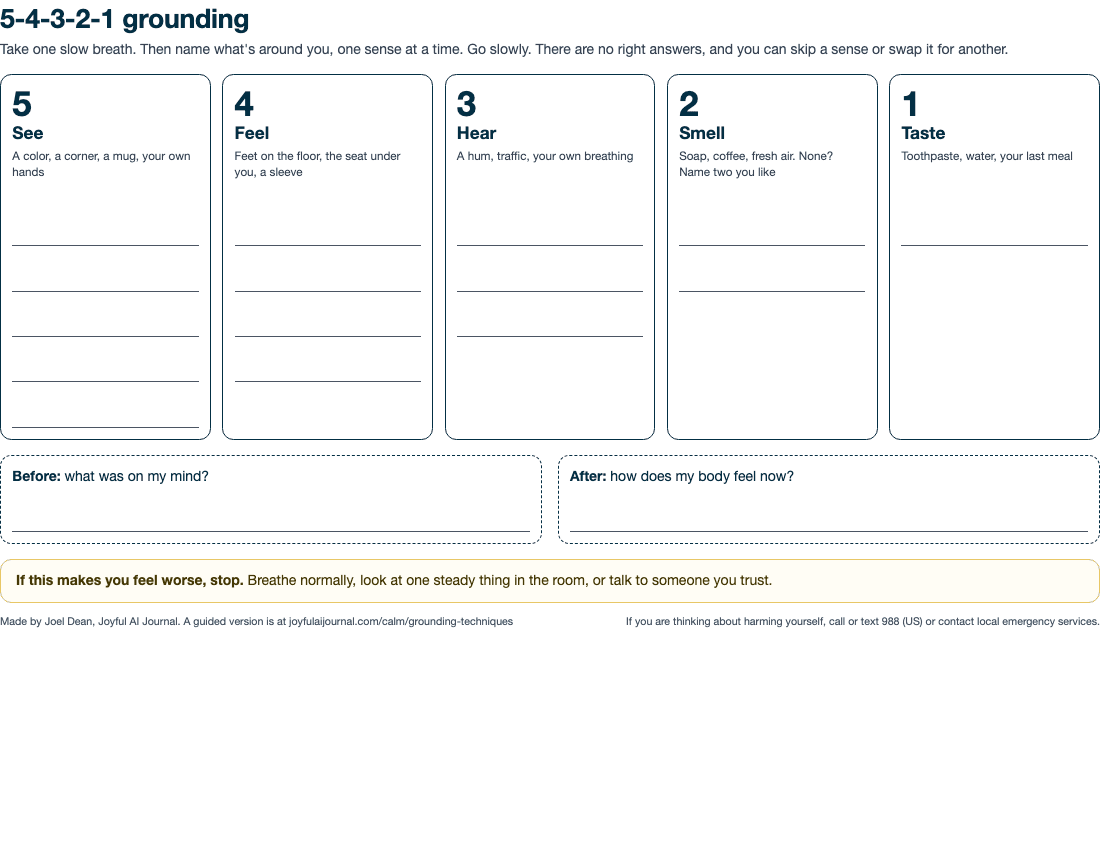
- US Letter: /printables/grounding-worksheet-letter.pdf
- A4: /printables/grounding-worksheet-a4.pdf
Fill it in once on a calm day, so the steps already feel familiar when you need them.
Questions people ask
How long does 5-4-3-2-1 take?
About 2 to 5 minutes, depending on how slowly you go. Take it slowly; the point is to stay with each thing you name for a second.
Does the 5-4-3-2-1 method really work?
Cleveland Clinic describes it as a way to bring your attention into the present moment.2 Without a trial of it on its own, nobody can say how well it works or for whom.4 It costs nothing to try, and you can stop if it doesn't help.
What is the 3-3-3 rule?
Name 3 things you see, 3 sounds you hear, and move 3 parts of your body. It's a shorter cousin of 5-4-3-2-1, for when you only have a minute.
What is the most effective grounding technique?
There isn't a proven best one, because no study has compared them. Try two or three on a calm day and keep the one you can do anywhere.
Is grounding the same as earthing?
No. "Earthing," also called grounding in the wellness world, means touching the earth with bare skin for supposed electrical effects. Grounding in mental health is about attention, and has nothing to do with electricity.
Related
- Box breathing: a pacer for slowing your breath, for when your body feels revved up.
- Panic attacks: what's happening and what helps in the moment.
- Calm in the moment: the rest of this section.