4-7-8 breathing

Press Start and breathe along: in through your nose for 4, hold for 7, out through your mouth for 8. Four rounds take just over a minute.
4-7-8 breathing: 4 rounds, about 1 min 16 sec.
If you feel dizzy, short of breath or more anxious, stop and breathe normally. A shorter count is fine. If you're thinking about harming yourself, call or text 988 in the US, or see crisis resources.
Prefer paper? Download the one-page breathing guide (PDF). It has 4-7-8 on it too.
How to do 4-7-8 breathing
These steps follow Dr. Andrew Weil's own handout.1
- Sit with your back straight if you can. Rest the tip of your tongue on the ridge just behind your top front teeth, and keep it there.
- Breathe all the way out through your mouth, around your tongue, with a soft whoosh.
- Close your mouth. Breathe in quietly through your nose for a count of 4.
- Hold your breath for a count of 7.
- Breathe out through your mouth, with the whoosh, for a count of 8. That's one breath.
- Do 3 more, for 4 in all. Weil says not to do more than 4 at a time for the first month.1
If holding for 7 is hard, count faster.
Weil's handout says the 4-7-8 ratio matters more than how long each count lasts, so a count of 7 doesn't have to be 7 real seconds.1
"Lying in bed at 1 a.m., I did four rounds, counting fast because the 7 felt long. By the third one my shoulders had come down from my ears."
What was going on in your body before you started, and what changed by the fourth breath, if anything?
Answer this with JoyWhere the numbers come from
It's a breathing pattern with a long hold and an even longer breath out, made popular by Dr. Andrew Weil, an integrative medicine doctor, with roots in pranayama, the breathing practices of yoga.2
- Empty: Breathe all the way out through your mouth.
- In for 4: Quietly, through your nose.
- Hold for 7: Keep your tongue behind your top teeth.
- Out for 8: Through your mouth, with a whoosh. Then start again.
At one count per second, a round takes 19 seconds. That's about 3 breaths a minute. The breath out is twice the breath in, and the hold is the longest single part.
What the trials found, and what they didn't
The trial evidence for 4-7-8 itself is thin. Researchers writing in 2025 began their paper by calling 4-7-8 and box breathing "popularly promoted by psychotherapists but have little empirical support".3
What exists is small. Heart rate and systolic blood pressure dropped in 43 young adults right after three sets of six 4-7-8 breaths, but with no other breathing pattern to compare against, that shows what happened and not that 4-7-8 beat anything.4
The most favorable result comes from a trial in surgery patients. Among 90 patients recovering from weight loss surgery, randomly assigned to 4-7-8, ordinary deep breathing or routine care, the 4-7-8 group ended with lower anxiety scores than both.5 It was one trial, in one setting.
In one head-to-head lab test, a steady 6 breaths a minute did more for heart rate variability than 4-7-8; the comparison page has the details.3 Slow breathing as a group does better on evidence, with a small drop in anxiety across 20 randomized trials of breathwork.6
And "asleep in 60 seconds"? We couldn't find a study behind it.
4-7-8 is a reasonable thing to try, and plenty of people like having the counts to hold onto. If the long hold bothers you, in for 4 and out for 6 has at least as much support.3
Does 4-7-8 breathing help you sleep?
Weil suggests it for falling asleep.1 No trial we could find measured whether it gets people to sleep faster. Still, in bed it gives your attention something calm and low-effort to do, which is a fair reason to try it.
If you've been lying awake most nights for weeks, we'd look past a breathing trick. For long-term insomnia, the American College of Physicians recommends cognitive behavioral therapy for insomnia as the first treatment.7 What it teaches is on how to fall asleep fast.
Lightheaded on the first try
That's common at first, and Weil and Cleveland Clinic both say it usually passes with practice.1,2
- Stop if you feel dizzy, short of breath, tingly, or more anxious, and breathe normally. Next time count faster, or switch the pacer to the longer exhale, which has no hold.
- Ask a doctor first if you have trouble breathing, use oxygen, or get dizzy easily.8 Relaxation techniques are generally safe for healthy people, with rare reports of worse symptoms in people with epilepsy, some psychiatric conditions, or a history of trauma.9
- Switch tools if breathing exercises make panic worse: 5-4-3-2-1 grounding doesn't use the breath at all, and what helps during a panic attack covers the rest.
If you're thinking about harming yourself, call or text 988 in the US, or see crisis resources.
Print it
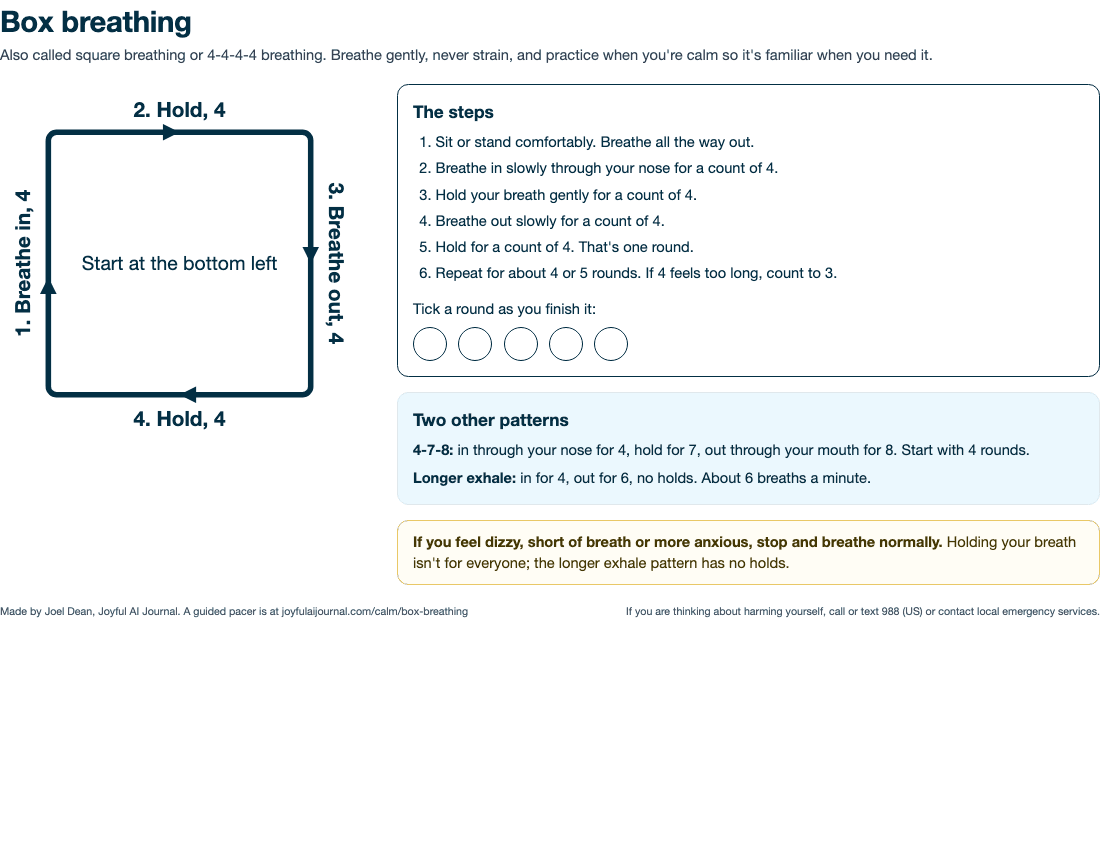
- US Letter: /printables/box-breathing-worksheet-letter.pdf
- A4: /printables/box-breathing-worksheet-a4.pdf
One page, black and white, with 4-7-8, box breathing and the longer exhale.
Questions people ask
How does 4-7-8 breathing work?
Nobody knows whether the 7-count hold adds anything, because it hasn't been tested on its own. What the pattern certainly does is slow you to about 3 breaths a minute with a long breath out, and slow breathing in general goes with more relaxation and less anxiety in healthy adults, on evidence one review called limited.10
Is 4-7-8 breathing harmful?
Not for most healthy people. Feeling lightheaded the first few times is common; stop and breathe normally if it happens.1 With a breathing problem or easy dizziness, check with your doctor first.8
How many times should I do 4-7-8 breathing?
Four breaths at a time, at most, for the first month, and at least twice a day, says Weil's handout. Later you can build up to 8.1
How long does it take to fall asleep with 4-7-8 breathing?
Unknown. No study has timed it. Use it to settle, and notice whether it helps.
Is 4-7-8 or box breathing better?
Neither has clearly won. The box breathing vs 4-7-8 comparison goes through the one head-to-head study and how to choose.
Related
- Box breathing: in, hold, out, hold, for 4 each, with the same pacer.
- Box breathing vs 4-7-8: how the two compare, and a third pattern that did better.
- Breathing exercises for anxiety: five patterns and what the trials found.
- Calm in the moment: every tool in this section.