Journal prompts

How to use these prompts. Find the group that sounds like today and answer one prompt from it. Five minutes is a full entry, and so is one honest line. If a prompt stirs up more than you want to hold right now, stop. It'll keep. If you're struggling to stay safe, use these crisis resources.
When you don't know what to write
For a first entry, or any day the page stays blank. Start with what's in front of you.
What has taken up the most room in my head today, even if it's small?
Answer this with JoyDescribe the last hour as if you were telling a friend who wasn't there.
Answer this with JoyScan from my jaw down to my feet. Where is there tension, and what one word would I give it?
Answer this with JoyMorning, before the day starts
Two or three lines, looking ahead. The third prompt is shaped as an if-then plan on purpose: deciding in advance "if this happens, I'll do that" makes people more likely to follow through on a goal.1
The part of today I'm least looking forward to is ___. The smallest step that makes it easier is ___.
Answer this with JoyWhat am I carrying over from yesterday that I could set down until later?
Answer this with JoyEvening, looking back on today
Keep it to what happened and how it felt.
What did I say yes to today that I'd say no to next time, or the other way around?
Answer this with JoyWhat's still on my mind as the day ends, and when tomorrow could I give it ten minutes?
Answer this with JoyWhen your head is full
Racing thoughts, or one worry on repeat. Every prompt here asks what or how. Concrete thinking about a problem tends to help, and abstract replaying of why it happened tends to keep it going.2 The pages for anxiety and overthinking go further.
What do I expect will happen, and on what date will I know whether it did?
Answer this with JoyWhich part of this can I do something about today, and which part can only wait?
Answer this with JoyWhere do I feel this in my body right now, and does it shift as I write?
Answer this with JoyIf a friend brought me this exact worry, what would I say to them?
Answer this with JoyPeople and relationships
After a conversation that stayed with you, good or hard. Write down the words first, as close as you can get them. What they meant can wait a paragraph.
What did they say, as close to word for word as I remember, and what did I hear in it?
Answer this with JoySomething I haven't said to someone is ___. The first sentence I'd use, if I did, is ___.
Answer this with JoyWhere in this relationship do I give more than I get, or get more than I give?
Answer this with JoyWork and the load you carry
For the workday that follows you home. The list never gets shorter, so these ask which items are worth your time.
What took most of my energy this week, and was it the thing that mattered most?
Answer this with JoyA task I keep putting off is ___. The first five minutes of it would look like ___.
Answer this with JoyGetting to know yourself
Every prompt in this group asks about something you did, or something other people come to you for. Asking yourself why only gets you so far: people often learn more about themselves from their own behavior, and from how others see them, than from looking inward.3 For a longer set, see journal prompts for self-discovery.
What do people tend to come to me for, and how do I feel about that?
Answer this with JoyA value I say matters to me is ___. The last time I acted on it was ___.
Answer this with JoyWhat did I believe five years ago that I don't believe now, and what changed it?
Answer this with JoyGood moments and small wins
Gratitude and small wins. No need to make this one daily: counting good things once a week may suit people better than three times a week.4 There's more on keeping a gratitude journal.
Describe one good moment from today in full detail: the sounds, the light, who was there.
Answer this with JoyWhy the prompts end on what happens next
Most of these prompts ask what happened, then what you'll do. Writing about hard things helps a little on average (a review of 146 studies put the effect at r = .075),5 and how you write seems to matter. How to start journaling walks through those studies.
Three findings from that research are built into the prompts.
Thoughts and feelings together seem to beat feelings alone. Students who spent a month writing about both their thoughts and their emotions about a stressful event came to see more benefits in it, while those who wrote only about emotions reported more illness symptoms.6
Naming a feeling may take some of the edge off it,7 so the body-scan prompt asks for one word. The list of emotions has words to choose from when "bad" is all that comes.
And an entry can leave you more stirred up than when you started, which is why the steps below say heavy is allowed. That happened in the first of these studies, where students felt more upset right after writing and still made fewer health center visits over the next six months.8 A heavy feeling after an entry doesn't mean you did it wrong.
- Pick one: Choose the group that matches your moment, then one prompt.
- Five minutes: Write or speak without fixing spelling or sense.
- Stop when it's enough: Heavy is allowed. You can leave a prompt half-answered.
- One next step: End with one line on what, if anything, you'll do.
If the same entry keeps coming back
Some weeks the prompts keep landing on the same heavy thing: the sleep that won't come, the mood that won't lift, the worry you've written down six times. That pattern is worth taking to someone trained to help.
Bring the entries with you: they say in your own words what's been happening and on which days, and that's hard to remember on the spot.
If you're not safe, call or text 988 in the US, or find help in other countries.
Print these prompts
All 48 prompts on two pages, with room to write under each group.
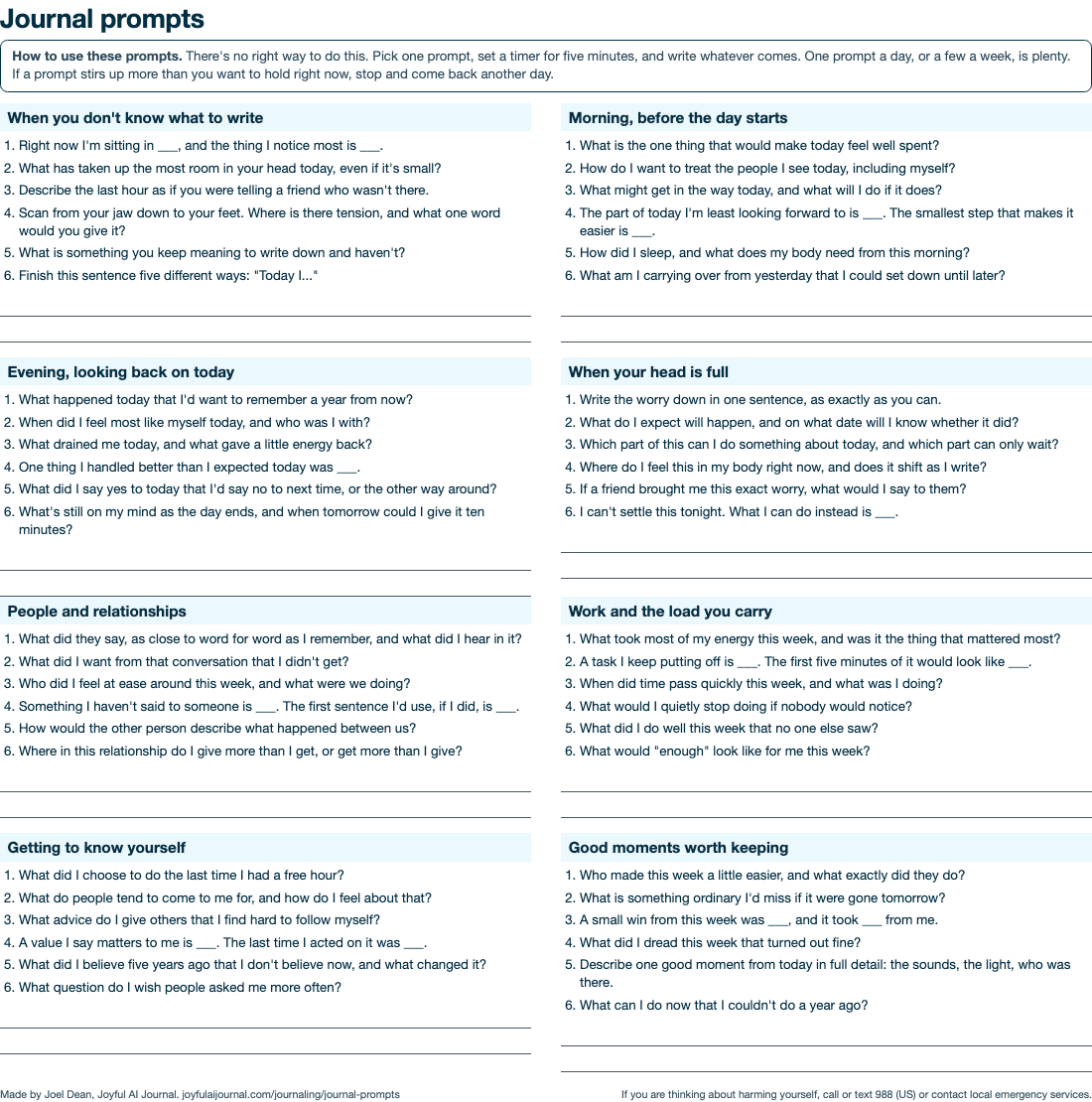
- US Letter: /printables/journal-prompts-worksheet-letter.pdf
- A4: /printables/journal-prompts-worksheet-a4.pdf
Questions people ask
What are good journal prompts?
Open and specific. "How was your day?" gets a one-word answer, and "When did I feel most like myself today?" gets a moment you can describe. The best one is usually whichever matches what you're already thinking about.
What is the 3-3-3 journaling method?
It's a format shared on social media and journaling blogs, and the versions differ from site to site. We couldn't find any research on it. If a fixed shape gets you started, use it, and drop it the day it feels like a chore.
How many prompts should I answer at once?
Answer one honestly rather than five in a rush. The first big writing study used 15 minutes on four days in a row, which is far less than a daily habit.8
Can I answer journal prompts out loud?
Yes. In a small study of 57 students, people who talked about stressful events showed immune changes in a blood test at least as large as people who wrote about them.9 In the Joyful app you can answer any prompt by voice with Joy, who asks one follow-up question and keeps a written summary for you.
Should I reread my old entries?
Give it a few weeks first. Rereading can show you a pattern you'd miss day to day: the worry that never came true, or the one person who keeps making things easier. If it pulls you back into a hard time, skip it.
More prompts and tools
New to this? Start with how to start journaling. For a specific moment, see the prompts for anxiety, overthinking, self-love, grief or new beginnings, or the more inward shadow work prompts. If one thought keeps looping, try the thought record.