Ikigai

List what you love, what you're good at, what the world needs and what you can be paid for, then see where they overlap. Nothing you type leaves your device.
What you love
One per line. Small counts: cooking for friends, long walks, fixing things.
Nothing yet. You can leave a list empty.
If thinking about this leaves you feeling low, it's fine to stop and come back another day, or to talk it over with someone you trust. If you're thinking about harming yourself, call or text 988 in the US, or see crisis resources.
Prefer paper? Download a blank worksheet (PDF).
How to use it
- Write what you love, one thing per line. Small counts: Sunday cooking, fixing bikes, long talks with your sister.
- Write what you're good at, including the things people come to you for, like "explaining the forms" or "calming a room" when everyone else is shouting.
- Write what the world needs that you could give. Your world can be your street.
- Write what you can be paid for, now or with practice. Leave it blank if money isn't part of this for you.
- On the overlap step, tap the lists each thing belongs to. Cooking might be in love and good at, but not paid for.
- Read your map. Then answer the prompt under it.
It takes about 10 minutes. Go slowly on step 5.
Which one thing on your map would you most like more of in an ordinary week, and what is the smallest step toward it?
Answer this with JoyA word for small things, and a 2014 drawing
In Japanese, ikigai is most often translated as "a sense of life worth living".1 It's an everyday word. Ken Mogi, a Japanese neuroscientist, describes it as part of daily life, careers, relationships and hobbies.2 An ikigai can be a grandchild, a garden or a morning walk, and it doesn't have to be a job or pay anything.
The popular four-circle chart is not Japanese at all.
In 2014 the writer Marc Winn added the word "ikigai" to a purpose diagram drawn by the Spanish astrologer Andrés Zuzunaga. Winn has since said that adding the word was his whole contribution.3 A 2022 Japanese government article, built on an interview with Héctor García, co-author of the 2016 book Ikigai, walks through the four circles and credits Winn for the drawing.4
This worksheet uses Winn's version, and that changes the question. The diagram asks for one thing that sits in all four circles, money included. The Japanese idea asks something smaller: what makes today feel worth living?
The word was in Japanese writing long before the diagram. The psychiatrist Mieko Kamiya wrote a whole book about it, Ikigai ni tsuite ("About ikigai"), in 1966.5
- The four-circle diagram (2014): One thing you love, are good at, the world needs and you can be paid for.
- The everyday Japanese sense: Whatever makes your life feel worth living, from your work to the joy of little things.
One question asked of 43,391 people
Japanese researchers have studied ikigai as a feeling, not as a diagram. The Ohsaki Study asked 43,391 Japanese adults a single question: "Do you have ikigai in your life?"1
Over the next 7 years, people who answered no had about 1.5 times the risk of dying, mainly from heart disease and outside causes, and not from cancer.1
That's a link in observational data. It can't show that finding an ikigai makes anyone live longer, since poor health could lower both.
We found no study that tested the four-circle worksheet itself. Use it to sort your thoughts; it doesn't measure anything.
What your map can and can't tell you
It can put your lists side by side, so an overlap you hadn't named becomes visible: something you love and are good at that nobody asks you for yet, say.
It can't tell you what job to take. Your map isn't a score.
An empty middle isn't a verdict. Winn's diagram asks for one thing in all four circles, which is a high bar. If yours is empty, look at the two-circle areas, and at what you love that nothing else on the map holds.
If the exercise leaves you feeling low, or stuck comparing yourself with others, stop and come back another day. Talking it over with someone you trust is another way in.
Print or save it
The last step of the tool has a Print button that prints only your map and your lists. Nothing is stored, so print it before you leave the page.
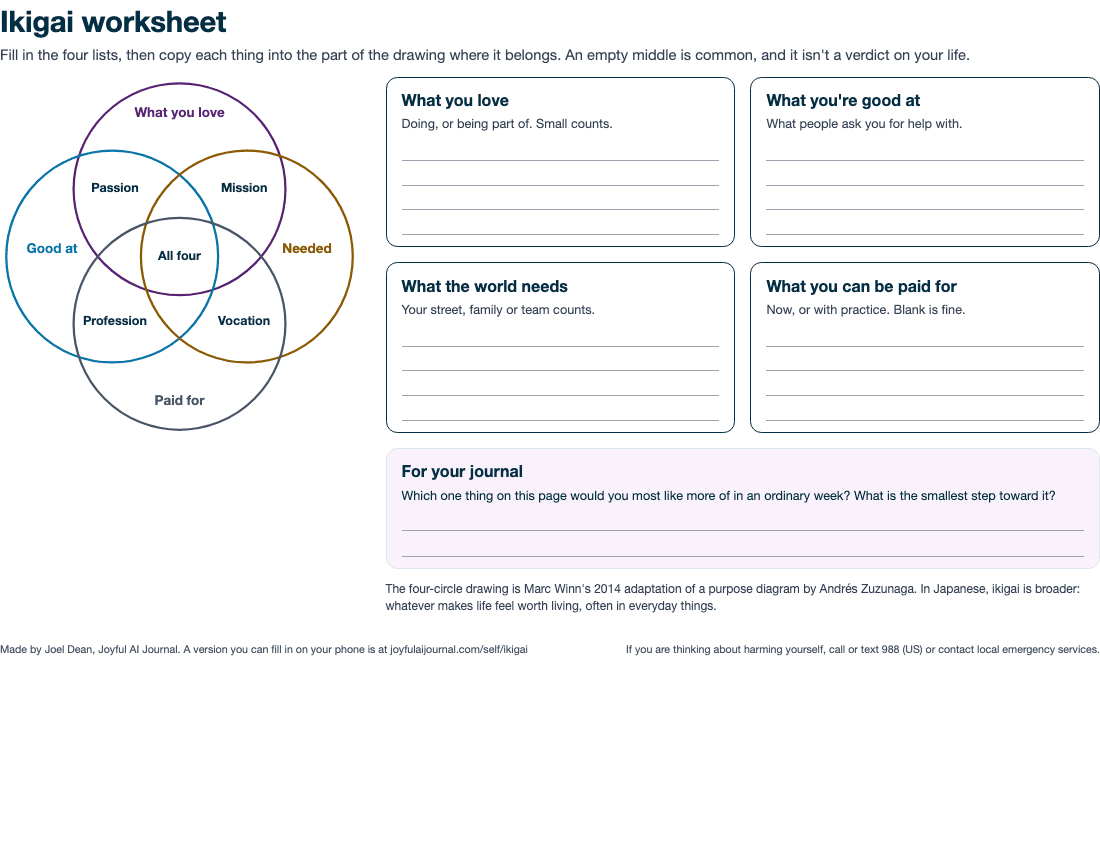
- US Letter: /printables/ikigai-worksheet-letter.pdf
- A4: /printables/ikigai-worksheet-a4.pdf
The blank worksheet prints well in black and white.
Questions people ask
What does ikigai mean?
Roughly "a sense of life worth living".1 In everyday Japanese it stretches to a hobby or a person as easily as to work.2 The four circles are a later Western version.3
What are the 10 rules of ikigai?
They come from García and Miralles's 2016 book, which drew on interviews in the village of Ogimi in Okinawa.6,4 They're the authors' own summary of those interviews, not a traditional Japanese list.
What are the 5 pillars of ikigai?
They're from Ken Mogi's book: starting small, releasing yourself, harmony and sustainability, the joy of little things, and being in the here and now.2
Is ikigai overhyped?
The word itself isn't. The diagram gets sold as an ancient Japanese formula for a perfect career, but it's a 2014 blog drawing.3 As a prompt for thinking, it's harmless and can be useful.
Do I need my ikigai to be my job?
No. Mogi counts relationships and hobbies as sources of ikigai alongside work.2 In this tool you can leave the paid-for list empty and the map still draws.
Related
- Burnout: when work keeps taking more than it gives.
- How to stop procrastinating: for when you know the step and still can't start it.
- Imposter syndrome: for when you doubt the "good at" list.