Wheel of life

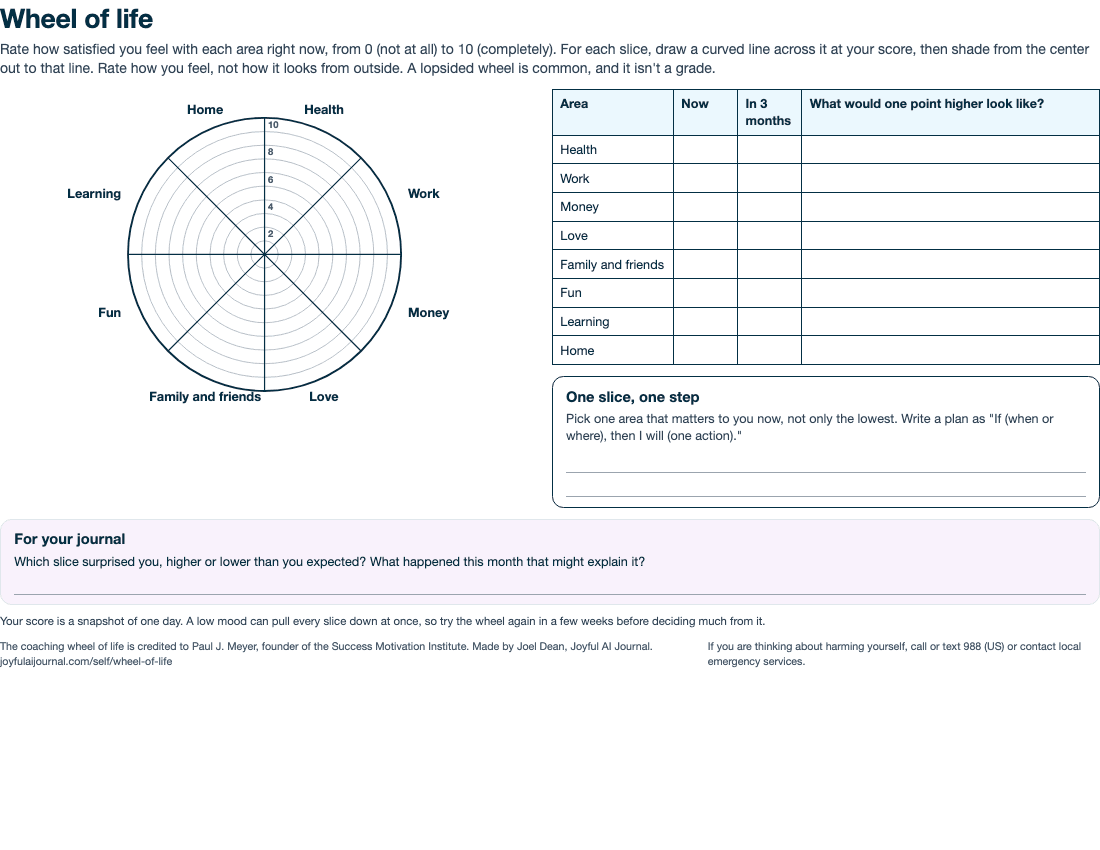
The wheel of life is a coaching exercise. You split a circle into eight slices, one per area of life, and rate how satisfied you feel with each from 0 to 10. The shape shows where things feel full and where they feel thin. It's a snapshot of one day, and we found no study that checks it as a measure.
Download the free wheel of life worksheet (PDF). It prints on one page and takes about 15 minutes.
Rating your wheel in five steps
- Rate: Score each area from 0 to 10 for how satisfied you feel right now.
- Shade: Shade each slice from the center out to your score.
- Look: Notice the shape. Where is it full, and where is it thin?
- Pick: Choose one slice that matters to you now, not only the lowest.
- Plan: Write one "If this happens, then I will do that" step.
Rate how it feels to you. How it would look to someone else doesn't count here, and a big salary can still be a 4 if money worries you every night.
Then go slowly on step 4. The eye jumps to the lowest slice, but the one worth working on may be a 6 that would make a bigger difference to your week.
The eight slices on our printable
Wheels online use different areas. These eight are common ones, and the printable uses them; swap any that don't fit your life for faith, creativity, caring for a parent or whatever takes up real room in your week. The examples are made up.
Health
Sleep, energy, eating, movement and how your body feels.
"Health: 5. I sleep fine, but I haven't exercised since spring."
Work
Your job, studies or the work you do at home, and how it feels to do it.
"Work: 7. I like the team. The commute takes two hours a day."
Money
How secure and in control you feel about it. The balance in the account matters less here.
"Money: 3. I'm not behind, but one surprise bill would put me there."
Love
A partner, or how you feel about romance and being single.
"Love: 8. We're good. We just need a night out that isn't about the kids."
Family and friends
The people you rely on and who rely on you.
"Family and friends: 4. I see people at work and nowhere else."
Fun
Play, hobbies and things you do only because you enjoy them.
"Fun: 2. I can't remember the last thing I did just for fun."
Learning
New skills, reading, curiosity and feeling like you're moving forward.
"Learning: 6. I started Spanish on an app and I'm still doing it, most days."
Home
Where you live and how it feels to be there.
"Home: 7. It's small, but it's quiet and the light is good."
A coaching drawing with a borrowed name
The coaching wheel is credited to Paul J. Meyer, founder of the Success Motivation Institute. "Wheel of Life" is a trademark of the Meyer Resource Group.1 We found no record of the year he first drew it.
The Buddhist wheel of life, the bhava-cakra, is something else: a traditional image of the cycle of rebirth.2 The coaching wheel borrowed its name and left the teaching behind.
The 2 that swallows the 7s
One low score drags your eye and your mood. Five slices sit at 7, and the only number you can think about for the rest of the evening is the 2.
Then there's the urge to score yourself the way you think you should feel. "I have a good job, so work must be an 8." The wheel only works if the numbers are honest, and nobody else needs to see it.
And there may be a slice you'd forgotten was there. Fun is an easy one to forget.
Why one bad day can sink every slice
The wheel has never been tested as a measure. We found no published study of its reliability or validity, so use it to think, and don't compare your score with anyone else's.
Rating life by areas does have a research base. Life satisfaction is commonly measured by adding up satisfaction with separate areas, and when Robert Cummins sorted 173 area names used in earlier studies, about two thirds fit seven broad areas.3 Those seven are material well-being, health, productivity, intimacy, safety, community and emotional well-being.3 The wheel's slices are a looser version of the same idea.
Mood runs the other way, too. Ed Diener's review described two directions: good areas can add up to a good life, and a happy outlook can also make each area look better.4 On a low day every slice may drop at once.
If that happens, try the wheel again in a week before you decide much from it.
Whatever you focus on looks bigger. Students in the Midwest and California were about equally satisfied with life, yet both groups expected Californians to be happier, because they focused on the weather.5 Staring at your lowest slice can do the same thing to it.
A specific plan beats a wish. Specific, hard goals led to better performance than "do your best", across decades of studies.6 An if-then plan ("If it's Tuesday at 6, then I walk for 20 minutes") had a medium-to-large effect on reaching goals, across 94 tests.7 The printable ends with one for that reason.
From one slice to one plan
- Pick one slice. Three at once is a lot to carry. The slices overlap anyway: fun at 2 might lift with one plan to see a friend, which helps family and friends too.
- Ask what one point higher would look like. Forget what a 10 would be. "Money from 3 to 4" might mean one month's bills paid early.
- Write one if-then plan. Name when and where, then the action. Keep it small enough that you'd do it on a bad day.
- Check it against your values. A low slice that doesn't matter to you isn't a problem. The core values list is a way to see which slices matter most.
- Do it again in a month. Put the date on the sheet. The second wheel tells you more than the first, because you can see what moved.
When every slice is low
If most of your slices are low, and have been for weeks, put the worksheet down. Low scores everywhere can point to low mood rather than eight separate problems, and the depression check-in takes a few minutes to answer privately before you talk to anyone.
Joyful is an AI journaling companion, not therapy. Joy can keep track of how your weeks feel between wheels, and it can't replace care.
- US Letter: /printables/wheel-of-life-worksheet-letter.pdf
- A4: /printables/wheel-of-life-worksheet-a4.pdf
Which slice surprised you, higher or lower than you expected? What happened this month that might explain it?
Answer this with JoyQuestions people ask
What are the 8 areas of the wheel of life?
There's no fixed set. A common one is health, work, money, love, family and friends, fun, learning and home, and faith, creativity or community are frequent swaps.
How do you use the wheel of life?
Fifteen minutes and a pencil is enough. Rate, shade, pick one slice, write one plan, and put a date on the sheet so next month's wheel has something to compare against.
What does the wheel of life represent?
Your satisfaction across your life on one day, as you feel it. A wheel that looks lopsided to a friend can be exactly the shape you'd choose.
Is a balanced wheel the goal?
Not always. A new baby, an exam year or a family illness can make some slices thin for a while, and that can be the right call. What counts is whether the shape fits what matters to you now.