Vision board

A vision board is a collage of pictures and words for what you want, often made at the start of a new year. The catch most guides skip: in studies, daydreaming about the outcome on its own went with less effort and worse results.1 A board works harder for you when it also shows what's in the way and what you'll do about it.
How to make a vision board, step by step
This version keeps the pictures and adds the three parts with research behind them.
1. Pick one to three wishes
Choose wishes that matter to you, that stretch you, and that are possible. Fewer is better. Ten dreams on one board get a glance each. Two get your attention.
"Run a 10K by June. Have people over for dinner once a month."
2. Find one picture for each wish
This is the classic part. Pick an image that makes the outcome feel real: the finish line, a table full of friends. Give it the best spot on the board.
"A photo of a crowded kitchen table, cut from a food magazine."
3. Name the obstacle inside you
Next to each picture, write the main thing in you that gets in the way. Not the weather or your boss. A habit, a fear, a feeling.
"I skip runs when I'm tired after work. I put off inviting people because I worry my place is too small."
4. Add an if-then plan
For each obstacle, write one plan in this form: "If the obstacle happens, then I will do this." Make the action small and specific.
"If I get home tired, then I'll put on my running shoes and go for 10 minutes. If I start worrying about my place, then I'll text one person a date anyway."
5. Picture the steps, not only the finish
Add two to four small pictures or words for the process: shoes by the door, a training calendar, a shopping list. These are what you'll do on an ordinary Tuesday.
"A screenshot of week one of the training plan. A note that says: Sunday, send the group text."
6. Put it where you'll see it, and check in weekly
Hang it where you'll pass it every day, or make it your phone background. Once a week, mark what you did toward each wish. Writing progress down is part of what helps.2
"Week 3: two short runs, one long. Dinner invite sent, two said yes."
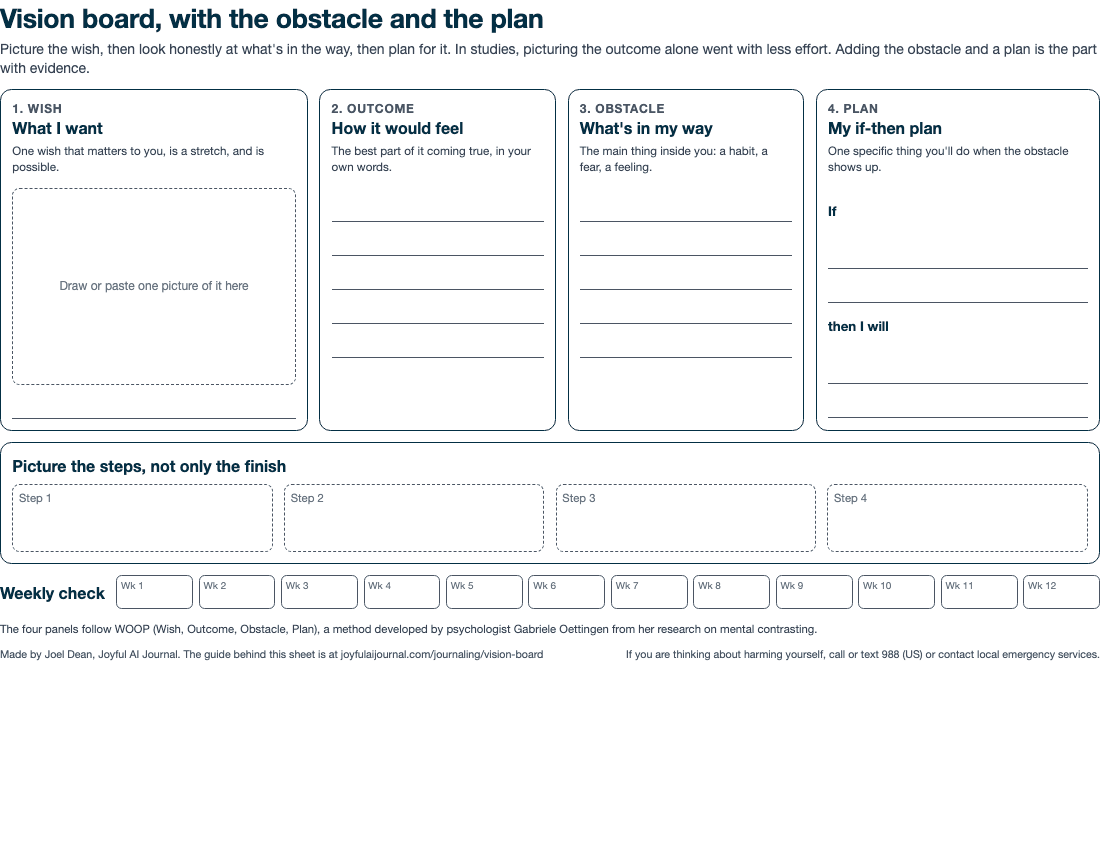
- Wish: Something that matters to you, is a stretch, and is possible.
- Outcome: The best part of it coming true, pictured for a minute.
- Obstacle: The main thing inside you that gets in the way.
- Plan: If the obstacle shows up, then I will do one specific thing.
Steps 1 to 4 follow WOOP, a method psychologist Gabriele Oettingen built from her research.3 The four parts also answer a question people often ask: what are the four sections of a vision board? WOOP's four make a good layout.
Vision board ideas
Many boards cover a few parts of life. Here is one wish for each of six common areas, with the obstacle and the plan that would sit beside it. Swap in your own.
- Health. Wish: walk most days at lunch. Obstacle: I eat at my desk and lose track of time. Plan: if it's 12:30, then I walk around the block before I eat.
- Career. Wish: lead one project this year. Obstacle: I stay quiet in planning meetings. Plan: if a new project comes up, then I'll say "I'd like to take this" before the meeting ends.
- Money. Wish: $1,000 saved for emergencies by December. Obstacle: I order takeout when I'm tired. Plan: if I'm too tired to cook, then I'll heat the frozen meal I keep for nights like this.
- Relationships. Wish: talk to my sister every week. Obstacle: I put it off until it's too late to call. Plan: if it's Sunday at 5, then I call her before dinner.
- Home. Wish: a bedroom I like waking up in. Obstacle: the whole room feels like too much to start. Plan: if it's Saturday morning, then I clear one shelf.
- Learning. Wish: hold a simple conversation in Spanish. Obstacle: I skip practice when I feel stuck. Plan: if I want to skip, then I do five minutes anyway.
For the picture, choose the best part of the wish, not the work: a trail at noon, your sister laughing, a clean shelf in morning light.
Print a vision board template
- US Letter: /printables/vision-board-worksheet-letter.pdf
- A4: /printables/vision-board-worksheet-a4.pdf
It's one wide page, with room to paste a picture, and it prints fine in black and white.
What a PubMed search found, and what it didn't
A vision board isn't magic, and it isn't useless: it's a picture of a wish, and what you add to it decides whether it moves you.
We searched PubMed on October 30, 2026 and found no studies with "vision board" in the title or abstract.4 As far as that search shows, no one has tested the board itself, though there is good research on the thinking a board asks you to do.
Picturing the outcome alone went with less effort
Gabriele Oettingen and Doris Mayer followed job seekers, students and patients recovering from hip surgery. People whose daydreams about the future were most positive put in less effort and did worse weeks or months later. People who judged success as likely did better.1
Positive fantasies can lower energy
People who imagined an ideal future showed less energy, in their bodies and their behavior, than people with more questioning or neutral thoughts, across four lab experiments.5
Adding the obstacle turned wishes into commitments
When people contrasted a wish with what stood in the way, they committed strongly to the wishes they had a real chance at, and less to the ones they didn't.6 A review of 21 studies of mental contrasting with if-then plans found a small to medium effect on reaching goals, possibly smaller given some publication bias.7
Picturing the process helped more than picturing the result
For five to seven days before a midterm, first-year college students pictured either how they'd study or the good grade itself.8 Picturing the studying led to more studying and better grades.8
The warm glow, then the dip
Making the board often feels good. Cutting out pictures of the life you want is pleasant, and that warm feeling can seem like progress. That's the moment to add the obstacle box, while the wish feels close.
A few weeks later, some people feel a dip: the board is still on the wall and nothing has changed. That's useful information, not a failure. Look at the obstacle and the plan. Usually the plan was too big, or the obstacle was a different one.
Some people feel worse looking at a board full of things they don't have. If yours leaves you feeling behind, take some pictures down. One wish you're working on beats ten that remind you what's missing.
When to make one
Any time works. Many people make a board around New Year's Day, and that timing has some support. Fresh starts, like a new year, a birthday or a Monday, are moments when people are more likely to start working on goals.9 If you're reading this in the fall, a board for the coming year can start with one wish you'd like to begin now.
What is one wish you'd put on a vision board this year? Write the best part of it coming true. Then write the main thing in you that might get in the way.
Answer this with JoyQuestions people ask
What do you put on a vision board?
Pictures and words for one to three wishes, plus, if you want it to help you act, the obstacle and an if-then plan for each. Add a few pictures of the steps, like running shoes or a calendar.
How do I make a vision board on my phone?
Any photo collage app or design tool works. Make a 9:16 image so it fits your lock screen, and leave space for the obstacle and plan in text. The printable above can also be photographed and set as a background.
Do vision boards work?
No study has tested vision boards directly.4 Research on the thinking behind them suggests picturing the outcome alone may lower effort, while adding the obstacle and a specific plan helps.1,7 A board with a plan has better odds than a board of pictures.
Is a vision board the same as manifesting?
No. Manifesting claims that focusing on what you want draws it to you. The version on this page uses the board as a plan you act on. See how to manifest and the law of attraction for the honest version of those ideas.
Related
- Goal setting: how to turn a wish into a goal that holds up.
- How to manifest and the law of attraction, and what's known about them.
- Affirmations for success, lines that point at the work.